Ch. 2 Chemistry Comes Alive
Marieb - Human Anatomy & Physiology 7th Edition
Marieb, Hoehn7th EditionHuman Anatomy & PhysiologyISBN: 9780805359091Not the one you use?Change textbook
Chapter 2, Problem 6

When a pair of electrons is shared between two atoms, the bond formed is called:
a. A single covalent bond
b. A double covalent bond
c. A triple covalent bond
d. An ionic bond

Verified step by step guidance
1
Understand that a covalent bond involves the sharing of electrons between atoms to achieve stability.
Recall that a single covalent bond is formed when one pair of electrons (two electrons) is shared between two atoms.
Recognize that a double covalent bond involves two pairs of electrons (four electrons) being shared, and a triple covalent bond involves three pairs (six electrons).
Differentiate covalent bonds from ionic bonds, where electrons are transferred rather than shared.
Conclude that when a pair of electrons is shared between two atoms, the bond formed is a single covalent bond.

Verified video answer for a similar problem:

This video solution was recommended by our tutors as helpful for the problem above.
Video duration:
2m
Was this helpful?

Key Concepts

Here are the essential concepts you must grasp in order to answer the question correctly.

Covalent Bond

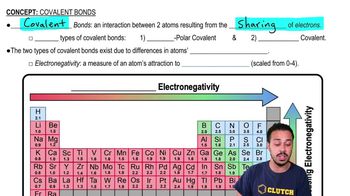
A covalent bond is a chemical bond formed when two atoms share one or more pairs of electrons. This sharing allows each atom to achieve a stable electron configuration, typically resembling that of noble gases.
Recommended video:
04:28
Covalent Bonds

Single, Double, and Triple Covalent Bonds

These terms describe the number of electron pairs shared between two atoms: a single bond shares one pair, a double bond shares two pairs, and a triple bond shares three pairs. The bond type affects the molecule's strength and properties.
Recommended video:
04:28
Covalent Bonds

Ionic Bond

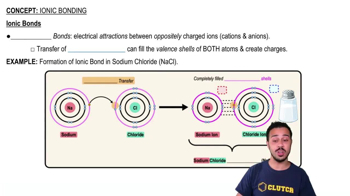
An ionic bond forms when one atom donates electrons to another, resulting in oppositely charged ions that attract each other. Unlike covalent bonds, ionic bonds involve electron transfer rather than sharing.
Recommended video:
06:07
Ionic Bonds