Ch. 7 The Nervous System
Marieb - Essentials of Human Anatomy & Physiology 13th Edition
Marieb13th EditionEssentials of Human Anatomy & PhysiologyISBN: 9780135624340Not the one you use?Change textbook
Chapter 7, Problem 14

What is the basis for the functional classification of neurons?

Verified step by step guidance
1
Understand that neurons are classified functionally based on the direction in which they transmit impulses relative to the central nervous system (CNS). This classification helps describe their role in the nervous system.
Learn about the three main functional types of neurons: sensory (afferent) neurons, motor (efferent) neurons, and interneurons. Each type has a distinct role in processing and transmitting information.
Sensory neurons transmit impulses from sensory receptors in the body (e.g., skin, organs) toward the CNS. They are responsible for detecting stimuli such as touch, temperature, and pain.
Motor neurons carry impulses away from the CNS to effectors such as muscles or glands, enabling responses like movement or secretion.
Interneurons, found exclusively within the CNS, act as connectors or integrators between sensory and motor neurons. They play a critical role in processing information and forming reflex arcs or complex neural pathways.

Verified video answer for a similar problem:

This video solution was recommended by our tutors as helpful for the problem above.
Video duration:
2m
Was this helpful?

Key Concepts

Here are the essential concepts you must grasp in order to answer the question correctly.

Functional Classification of Neurons

The functional classification of neurons categorizes them based on their roles in the nervous system. Neurons can be classified as sensory (afferent), motor (efferent), or interneurons. Sensory neurons transmit signals from sensory receptors to the central nervous system, motor neurons convey commands from the central nervous system to muscles or glands, and interneurons connect various neurons within the central nervous system.
Recommended video:
08:43
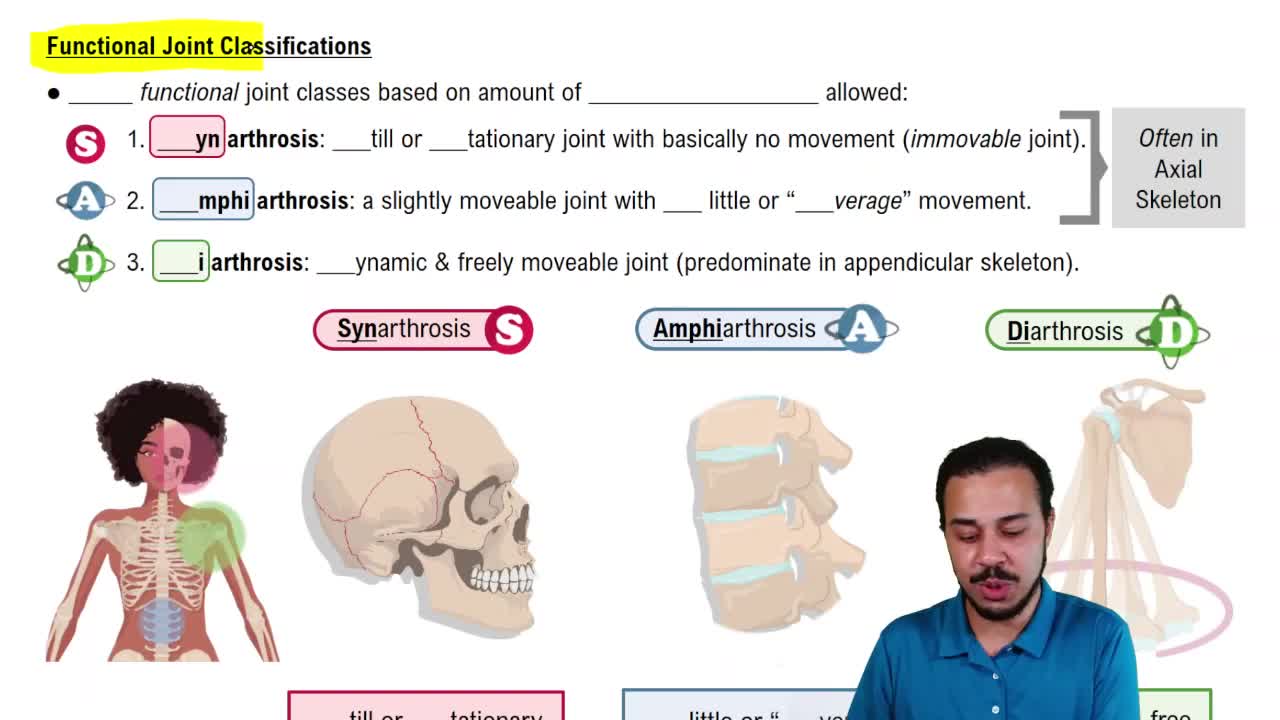
Functional Joint Classifications

Afferent and Efferent Pathways

Afferent pathways refer to the routes through which sensory information is sent to the central nervous system, while efferent pathways are the routes through which motor commands are sent from the central nervous system to effectors like muscles. This distinction is crucial for understanding how the nervous system processes information and coordinates responses, highlighting the flow of information in the body.
Recommended video:
4:40
Alternative Pathway

Interneurons

Interneurons are a type of neuron that serves as a connector or relay between sensory and motor neurons within the central nervous system. They play a critical role in processing information, reflexes, and complex behaviors by integrating signals from multiple sources. Interneurons are essential for higher cognitive functions and the coordination of motor activities.
Recommended video:
1:03
Visceral Reflex Arcs Example 1