Ch. 11 Fundamentals of the Nervous System and Nervous Tissue
Marieb - Human Anatomy & Physiology 7th Edition
Marieb, Hoehn7th EditionHuman Anatomy & PhysiologyISBN: 9780805359091Not the one you use?Change textbook
Chapter 11, Problem 5

Biogenic amine neurotransmitters include all but
a. Norepinephrine
b. Acetylcholine
c. Dopamine
d. Serotonin

Verified step by step guidance
1
Step 1: Understand what biogenic amine neurotransmitters are. These are neurotransmitters derived from amino acids and contain an amine group. Common examples include norepinephrine, dopamine, and serotonin.
Step 2: Review each option to determine if it fits the category of biogenic amine neurotransmitters. Norepinephrine, dopamine, and serotonin are all derived from amino acids and classified as biogenic amines.
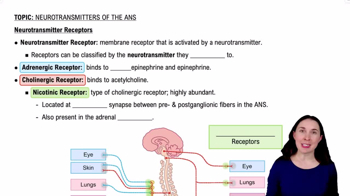
Step 3: Identify acetylcholine's classification. Acetylcholine is a neurotransmitter but it is not a biogenic amine; it is a quaternary ammonium compound synthesized from choline and acetyl-CoA.
Step 4: Conclude that acetylcholine is the exception in the list because it does not belong to the biogenic amine neurotransmitter group.
Step 5: Therefore, the correct answer is the neurotransmitter that is not a biogenic amine, which is acetylcholine.

Verified video answer for a similar problem:

This video solution was recommended by our tutors as helpful for the problem above.
Video duration:
2m
Was this helpful?

Key Concepts

Here are the essential concepts you must grasp in order to answer the question correctly.

Biogenic Amine Neurotransmitters

Biogenic amine neurotransmitters are chemical messengers derived from amino acids that contain an amine group. They include dopamine, norepinephrine, and serotonin, which play key roles in mood, arousal, and cognition.
Recommended video:
2:30
Neurotransmitter Receptors

Acetylcholine as a Neurotransmitter

Acetylcholine is a neurotransmitter that does not belong to the biogenic amine group. It is a choline ester involved in muscle activation and autonomic nervous system functions, distinct in structure and synthesis from biogenic amines.
Recommended video:
2:30
Neurotransmitter Receptors

Classification of Neurotransmitters

Neurotransmitters are classified based on their chemical structure and function. Understanding these categories helps differentiate between biogenic amines, amino acids, peptides, and other types, which is essential for identifying which neurotransmitters belong to each group.
Recommended video:
2:30
Neurotransmitter Receptors
Related Practice
Textbook Question

Match the names of the supporting cells found in column B with the appropriate descriptions in column A.

Column A 

_______ (1) myelinates nerve fibers in the CNS 

_______ (2) lines brain cavities 

_______ (3) myelinates nerve fibers in the PNS 

_______ (4) CNS phagocyte

________(5) helps regulate the ionic composition of CNS extracellular fluid

Column B

a. Astrocyte

b. Ependymal cell

c. Microglial cell

d. Oligodendrocyte

e. Satellite cell

f. Schwann cell

796
views
Textbook Question

Neuropeptides that act as natural opiates include

a. Substance P

b. Somatostatin and cholecystokinin

c. Tachykinins

d. Enkephalins

977
views
Textbook Question

Assume that an EPSP is being generated on the dendritic membrane. Which will occur?

a. Specific Na⁺ channels will open.

b. Specific K⁺ channels will open.

c. A single type of channel will open, permitting simultaneous flow of Na⁺ and K⁺.

d. Na⁺ channels will open first and then close as K⁺ channels open.

988
views
Textbook Question

Inhibition of acetylcholinesterase by poisoning blocks neurotransmission at the neuromuscular junction because

a. ACh is no longer released by the presynaptic terminal.

b. ACh synthesis in the presynaptic terminal is blocked.

c. ACh is not degraded, so prolonged depolarization is enforced on the postsynaptic cell.

d. ACh is blocked from attaching to the postsynaptic ACh receptors.

123
views
Textbook Question

Which of the following structures is not part of the central nervous system?

a. The brain

b. A nerve

c. The spinal cord

d. A tract

928
views
Textbook Question

The anatomical region of a multipolar neuron where the AP is initiated is the

a. Soma

b. Dendrites

c. Axon's initial segment

d. Axon terminals

1381
views
1
rank