Ch. 14 The Digestive System and Body Metabolism
Marieb - Essentials of Human Anatomy & Physiology 13th Edition
Marieb13th EditionEssentials of Human Anatomy & PhysiologyISBN: 9780135624340Not the one you use?Change textbook
Chapter 14, Problem 16

Bile emulsifies fat. Define emulsify.

Verified step by step guidance
1
Understand the term 'emulsify': Emulsification is the process of breaking down large fat globules into smaller, uniformly distributed droplets. This increases the surface area of fats, making them more accessible to digestive enzymes like lipase.
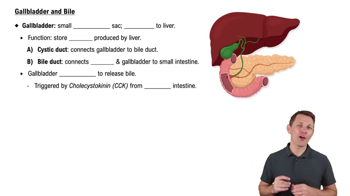
Recognize the role of bile: Bile, produced by the liver and stored in the gallbladder, contains bile salts that act as emulsifying agents. These bile salts have both hydrophobic (water-repelling) and hydrophilic (water-attracting) regions.
Learn how bile salts work: The hydrophobic region of bile salts interacts with fat molecules, while the hydrophilic region interacts with water. This dual interaction stabilizes the fat droplets in the watery environment of the digestive system.
Understand the importance of emulsification: By breaking down fat globules into smaller droplets, emulsification allows lipase enzymes to efficiently digest fats into fatty acids and glycerol, which can then be absorbed by the intestinal lining.
Connect emulsification to digestion: Emulsification is a critical step in fat digestion, as it ensures fats are properly processed and absorbed, contributing to energy production and other physiological functions.

Verified video answer for a similar problem:

This video solution was recommended by our tutors as helpful for the problem above.
Video duration:
2m
Was this helpful?

Key Concepts

Here are the essential concepts you must grasp in order to answer the question correctly.

Emulsification

Emulsification is the process of mixing two immiscible liquids, such as oil and water, to form a stable emulsion. In biological systems, emulsification is crucial for digestion, as it increases the surface area of fats, making them more accessible to digestive enzymes. Bile, produced by the liver, contains bile salts that act as emulsifiers, allowing fats to be broken down more efficiently in the digestive tract.

Bile Salts

Bile salts are amphipathic molecules derived from cholesterol, produced in the liver and stored in the gallbladder. They play a key role in the emulsification of fats by reducing the surface tension between fat droplets and water, allowing for better dispersion of fats in the digestive system. This action enhances the effectiveness of lipases, the enzymes responsible for fat digestion.
Recommended video:
Guided course
6:54
Gallbladder and Bile

Digestion of Fats

The digestion of fats involves breaking down large fat globules into smaller molecules that can be absorbed by the intestinal lining. This process begins with emulsification by bile salts, followed by enzymatic action from lipases that hydrolyze triglycerides into free fatty acids and glycerol. Efficient fat digestion is essential for nutrient absorption and energy production in the body.
Recommended video:
Guided course
6:28
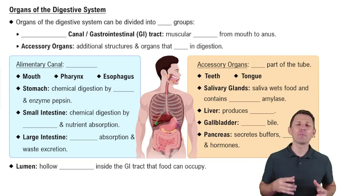
Organs of the Digestive System