
Ch. 3 Cells and Tissues
Marieb - Essentials of Human Anatomy & Physiology 13th Edition
Marieb13th EditionEssentials of Human Anatomy & PhysiologyISBN: 9780135624340Not the one you use?Change textbook
Chapter 3, Problem 10

What kind of connective tissue prevents muscles from pulling away from bones during contraction?
a. Dense connective
b. Areolar
c. Elastic connective
d. Hyaline cartilage

Verified step by step guidance
1
Understand the role of connective tissue in anchoring muscles to bones. Connective tissues provide structural support and stability during muscle contraction.
Review the characteristics of each type of connective tissue listed in the options: - Dense connective tissue: Contains tightly packed collagen fibers, providing strong tensile strength. - Areolar connective tissue: Loose and flexible, primarily involved in cushioning and support. - Elastic connective tissue: Contains elastic fibers, allowing for stretch and recoil. - Hyaline cartilage: Smooth and glassy, found in joints to reduce friction.
Focus on the specific function described in the question: preventing muscles from pulling away from bones during contraction. This requires a tissue with high tensile strength and durability.
Eliminate options that do not match the required function: - Areolar connective tissue is too loose and flexible for this role. - Elastic connective tissue is designed for stretch and recoil, not anchoring. - Hyaline cartilage is found in joints, not in muscle-bone connections.
Conclude that dense connective tissue, specifically tendons (a type of dense connective tissue), is responsible for anchoring muscles to bones and preventing them from pulling away during contraction.

Verified video answer for a similar problem:

This video solution was recommended by our tutors as helpful for the problem above.
Video duration:
4m
Was this helpful?

Key Concepts

Here are the essential concepts you must grasp in order to answer the question correctly.

Connective Tissue Types

Connective tissues are diverse groups of tissues that support, bind, and protect other tissues and organs in the body. They are classified into various types, including dense connective tissue, loose connective tissue, and specialized types like cartilage and bone. Understanding these categories is essential for identifying their specific functions and roles in the musculoskeletal system.
Recommended video:
Guided course
01:49
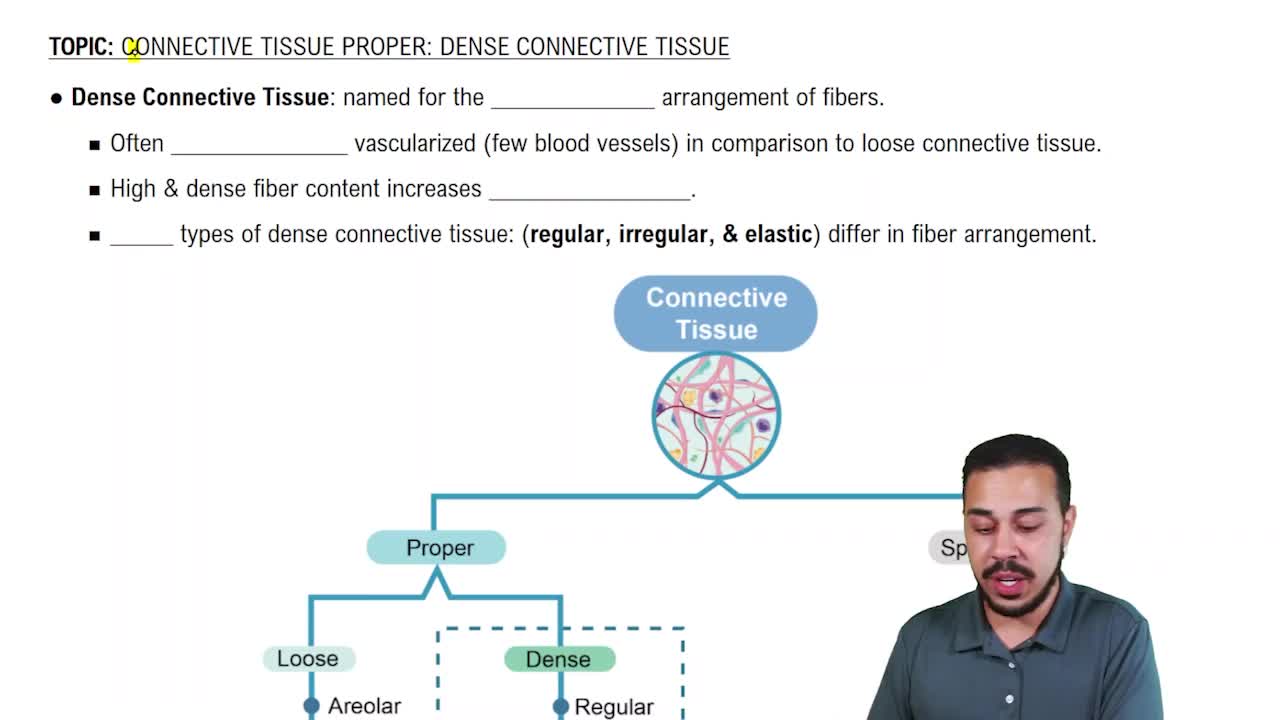
Connective Tissue Proper: Dense Connective Tissue Example 1

Dense Connective Tissue

Dense connective tissue is characterized by a high concentration of collagen fibers, which provide strength and resistance to stretching. This type of tissue is crucial in structures such as tendons and ligaments, where it helps anchor muscles to bones and stabilize joints during movement. Its tensile strength is vital for preventing muscles from pulling away from bones during contraction.
Recommended video:
Guided course
03:17
Dense Connective Tissue

Muscle Contraction Mechanics

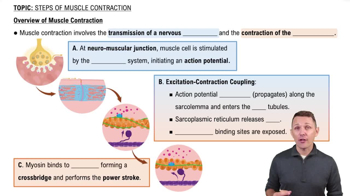
Muscle contraction involves the interaction between muscle fibers and connective tissues, allowing for movement and stability. When muscles contract, they exert force on tendons, which are made of dense connective tissue, pulling on bones. Understanding this mechanism is key to recognizing how connective tissues function to maintain the integrity of the musculoskeletal system during physical activity.
Recommended video:
Guided course
4:53
Overview of Muscle Contraction