Define radioactivity. If an element has three isotopes, which of them (the lightest, the one with an intermediate mass, or the heaviest) is most likely to be a radioisotope, and why?
Ch. 2 Basic Chemistry

Marieb13th EditionEssentials of Human Anatomy & PhysiologyISBN: 9780135624340Not the one you use?Change textbook
Chapter 2, Problem 17
Describe how the two 'generic' atoms shown below would form an ionic bond. Include in your answer where electrons come from, where they go, and why.
Verified step by step guidance1
Step 1: Understand the concept of ionic bonding. Ionic bonds form when one atom donates electrons to another atom, resulting in the formation of oppositely charged ions that attract each other. This typically occurs between a metal and a non-metal.
Step 2: Identify the role of each atom in the bond. The atom with fewer electrons in its outer shell (usually a metal) will lose electrons to achieve a stable electron configuration, becoming a positively charged ion (cation). The atom with more room in its outer shell (usually a non-metal) will gain electrons to achieve stability, becoming a negatively charged ion (anion).
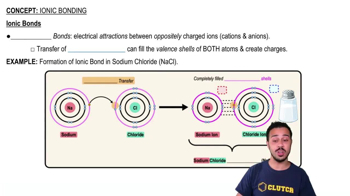
Step 3: Describe the movement of electrons. Electrons are transferred from the outer shell of the metal atom to the outer shell of the non-metal atom. This transfer allows both atoms to achieve a full outer shell, following the octet rule (or duet rule for smaller atoms like hydrogen).
Step 4: Explain the resulting charges. The atom that loses electrons becomes positively charged because it has more protons than electrons. The atom that gains electrons becomes negatively charged because it has more electrons than protons.
Step 5: Highlight the electrostatic attraction. The oppositely charged ions (cation and anion) are held together by strong electrostatic forces, forming the ionic bond. This bond creates a stable compound with a neutral overall charge.

Verified video answer for a similar problem:
This video solution was recommended by our tutors as helpful for the problem above.
Video duration:
1mWas this helpful?
Key Concepts
Here are the essential concepts you must grasp in order to answer the question correctly.
Ionic Bonding
Ionic bonding occurs when one atom donates an electron to another, resulting in the formation of charged ions. This process typically involves a metal atom losing one or more electrons to become a positively charged cation, while a non-metal atom gains those electrons to become a negatively charged anion. The electrostatic attraction between these oppositely charged ions creates a strong bond, stabilizing the compound.
Recommended video:
Ionic Bonds
Electron Transfer
In ionic bonding, electrons are transferred from the atom with a lower electronegativity (usually a metal) to the atom with a higher electronegativity (usually a non-metal). This transfer results in the formation of ions: the metal becomes a cation by losing electrons, and the non-metal becomes an anion by gaining those electrons. Understanding this transfer is crucial for explaining the formation of ionic compounds.
Recommended video:
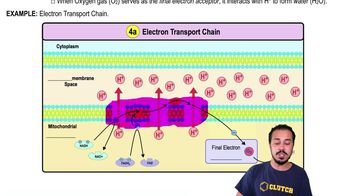
Electron Transport Chain
Electronegativity
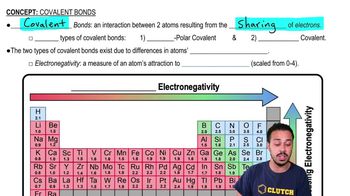
Electronegativity is a measure of an atom's ability to attract and hold onto electrons. In the context of ionic bonding, the difference in electronegativity between the two atoms determines the likelihood of electron transfer. A significant difference indicates that one atom will effectively pull electrons away from the other, leading to the formation of ions and the resulting ionic bond.
Recommended video:
Covalent Bonds
Related Practice
Textbook Question
56
views
Textbook Question
Distinguish inorganic from organic compounds, and list the major categories of each in the body.
108
views
Textbook Question
What are hydrogen bonds, and how are they important in the body?
206
views
Textbook Question
Name and provide the atomic symbols of the four elements that make up the bulk of all living matter. Which of these is found primarily in proteins and nucleic acids?
44
views
Textbook Question
Define molecule as it relates to molecular substances and compounds.
40
views
Textbook Question
Identify each of the following reactions as a synthesis, decomposition, or exchange reaction:
2Hg + O₂ 2HgO
Fe²¹ + CuSO₄ → FeSO₄ + Cu²¹
HCl + NaOH → NaCl + H₂O
HNO₃ → H⁺ + NO₃⁻
140
views