Pearson+ LogoPearson+ Logo
Ch. 1 The Human Body: An Orientation
Marieb - Human Anatomy & Physiology 7th Edition
Elaine N. Marieb, Katja Hoehn7th EditionHuman Anatomy & PhysiologyISBN: 9780805359091Not the one you use?Change textbook
Chapter 1, Problem 12

Define plane and section.

Verified step by step guidance
1
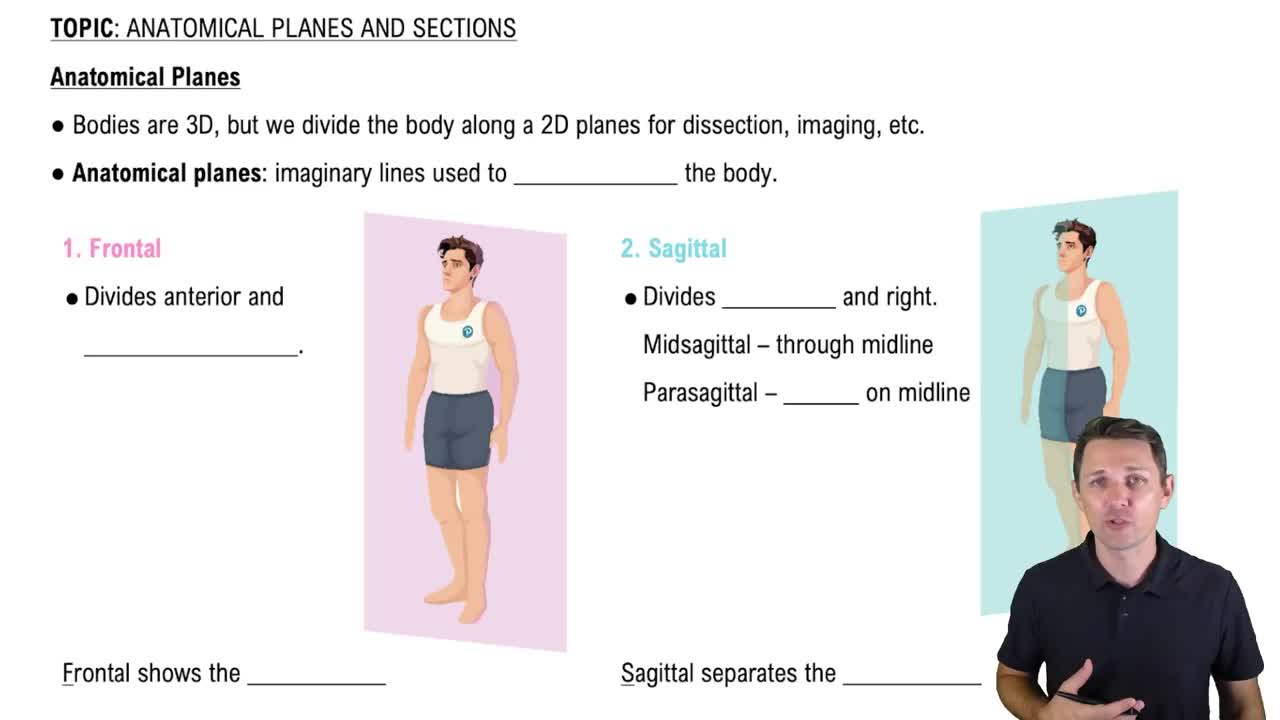
Step 1: Understand that in Anatomy & Physiology, a 'plane' refers to an imaginary flat surface that divides the body or an organ into sections. These planes help describe locations and directions in the body.
Step 2: Recognize the three primary anatomical planes: the sagittal plane (divides the body into left and right parts), the frontal (or coronal) plane (divides the body into front and back parts), and the transverse (or horizontal) plane (divides the body into upper and lower parts).
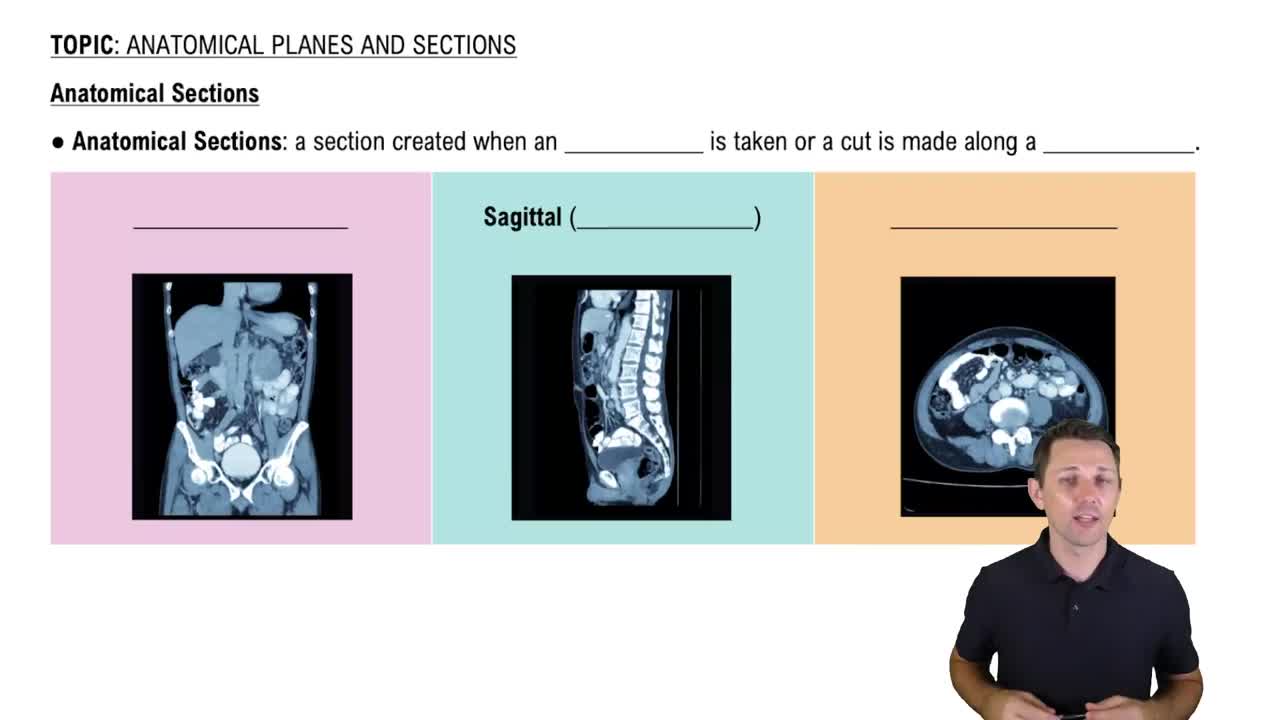
Step 3: Define a 'section' as the actual cut or slice made along one of these planes. It is the two-dimensional view or surface that results from slicing through the body or an organ.
Step 4: Note that sections are named according to the plane along which the cut is made. For example, a sagittal section is a cut along the sagittal plane.
Step 5: Summarize by stating that planes are the imaginary dividing lines, while sections are the physical or visual results of cutting along those planes.

Verified video answer for a similar problem:

This video solution was recommended by our tutors as helpful for the problem above.
Video duration:
1m
Was this helpful?

Key Concepts

Here are the essential concepts you must grasp in order to answer the question correctly.

Plane

A plane is a flat, two-dimensional surface that extends infinitely in all directions. It is defined by at least three non-collinear points and has length and width but no thickness. In geometry and anatomy, planes are used to describe locations and orientations of structures.
Recommended video:
Guided course
04:01
Anatomical Planes

Section

A section refers to the result of cutting through a structure along a plane, revealing its internal features. It helps visualize the arrangement and relationships of parts within an object or body by exposing a cross-sectional view.
Recommended video:
Guided course
02:33
Anatomical Sections

Anatomical Planes and Sections

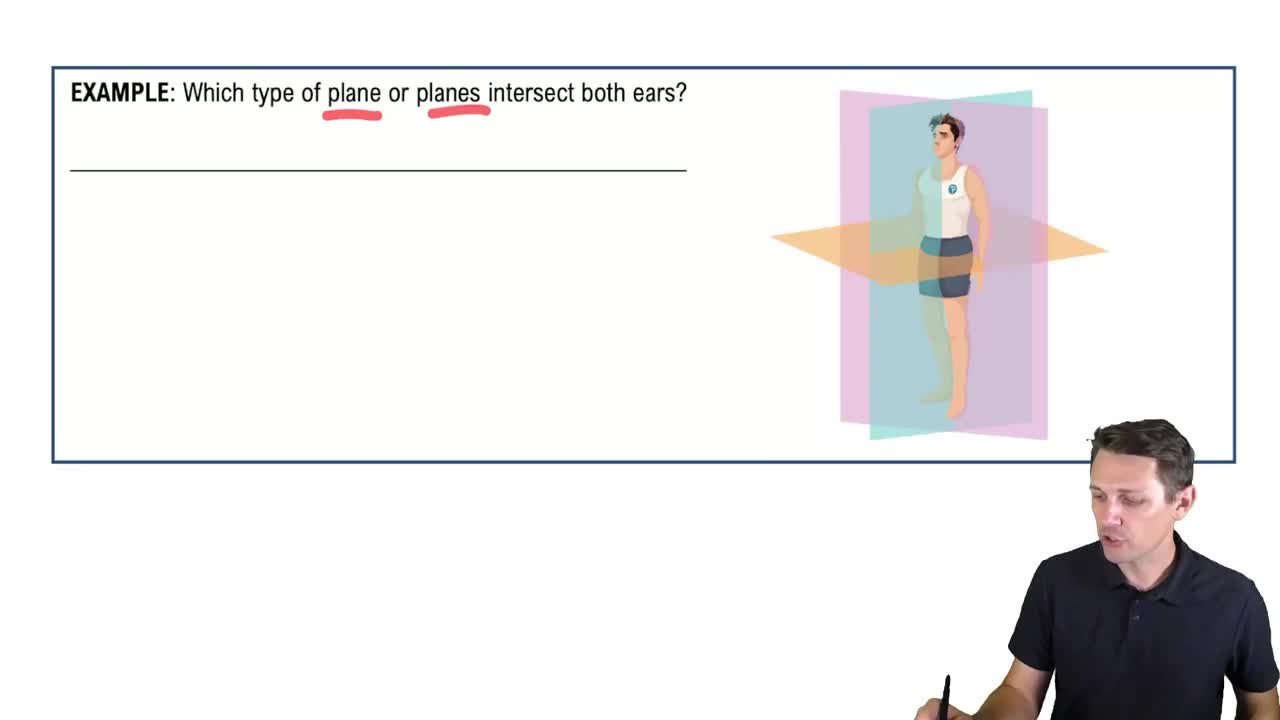
In anatomy, specific planes like sagittal, coronal, and transverse are used to create sections that divide the body into parts. Understanding these planes and corresponding sections is essential for describing locations and interpreting medical images.
Recommended video:
Guided course
02:06
Anatomical Planes & Sections Example 1