Ch. 10 The Muscular System
Marieb - Human Anatomy & Physiology 7th Edition
Elaine N. Marieb, Katja Hoehn7th EditionHuman Anatomy & PhysiologyISBN: 9780805359091Not the one you use?Change textbook
Chapter 10, Problem 1

A muscle that assists an agonist by causing a like movement or by stabilizing a joint over which an agonist acts is a(n):
a. Antagonist
b. Prime mover
c. Synergist
d. Agonist

Verified step by step guidance
1
Understand the role of an agonist muscle: it is the primary muscle responsible for producing a specific movement.
Recall that an antagonist muscle opposes the action of the agonist, producing the opposite movement.
Identify that a prime mover is another term for the agonist muscle itself, so it cannot be the assisting muscle.
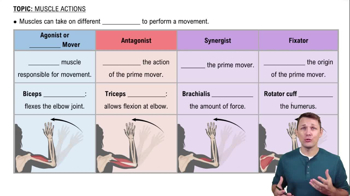
Recognize that a synergist muscle assists the agonist by either helping produce the same movement or stabilizing the joint to make the movement more efficient.
Conclude that the muscle described in the problem, which assists the agonist, is called a synergist.

Verified video answer for a similar problem:

This video solution was recommended by our tutors as helpful for the problem above.
Video duration:
2m
Was this helpful?

Key Concepts

Here are the essential concepts you must grasp in order to answer the question correctly.

Agonist (Prime Mover)

An agonist, or prime mover, is the main muscle responsible for producing a specific movement at a joint. It contracts actively to create the desired action, such as flexing the elbow or extending the knee.
Recommended video:
Guided course
5:41
Muscle Actions

Synergist

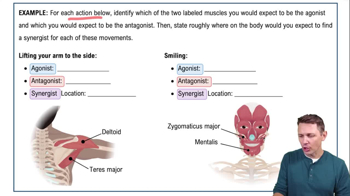
A synergist is a muscle that assists the agonist by either producing the same movement or stabilizing the joint to enhance the efficiency and smoothness of the action. It helps prevent unwanted movements and supports the prime mover.
Recommended video:
Guided course
3:55
Muscle Actions Example 1

Antagonist

An antagonist is a muscle that opposes the action of the agonist by producing the opposite movement. It relaxes or contracts to control or slow down the motion, ensuring coordinated and balanced muscle activity.
Recommended video:
Guided course
5:41
Muscle Actions