Pearson+ LogoPearson+ Logo
Ch. 20 The Lymphatic System and Lymphoid Organs and Tissues
Marieb - Human Anatomy & Physiology 7th Edition
Elaine N. Marieb, Katja Hoehn7th EditionHuman Anatomy & PhysiologyISBN: 9780805359091Not the one you use?Change textbook
Chapter 19, Problem 7

The red pulp areas of the spleen are sites of:
a. Splenic sinusoids, macrophages, and red blood cells
b. Clustered lymphocytes
c. Connective tissue septa

Verified step by step guidance
1
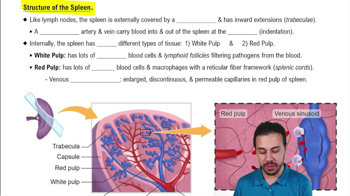
Step 1: Understand the structure of the spleen, which is divided into two main types of tissue: red pulp and white pulp.
Step 2: Recall that the red pulp primarily functions in filtering the blood, removing old or damaged red blood cells, and housing macrophages that phagocytize cellular debris.
Step 3: Recognize that the red pulp contains splenic sinusoids, which are specialized blood vessels that allow blood cells to pass through slowly for inspection and removal of defective cells.
Step 4: Note that the white pulp consists mainly of clustered lymphocytes and is involved in immune responses, not the red pulp.
Step 5: Connective tissue septa are structural components that support the spleen but are not specifically part of the red pulp's functional areas.

Verified video answer for a similar problem:

This video solution was recommended by our tutors as helpful for the problem above.
Video duration:
2m
Was this helpful?

Key Concepts

Here are the essential concepts you must grasp in order to answer the question correctly.

Red Pulp of the Spleen

The red pulp is a region in the spleen primarily involved in filtering the blood. It contains splenic sinusoids, which are specialized blood vessels, and is rich in macrophages that remove old or damaged red blood cells. This area plays a key role in blood filtration and immune response.
Recommended video:
10:09
Structure of the Spleen

Splenic Sinusoids

Splenic sinusoids are wide, irregular blood vessels found in the red pulp. Their unique structure allows blood cells to pass through slowly, facilitating the removal of defective red blood cells by macrophages. They are essential for the spleen’s blood-filtering function.
Recommended video:
10:09
Structure of the Spleen

Lymphoid Tissue in the Spleen

The spleen contains white pulp, which consists of clustered lymphocytes organized around central arteries. This area is responsible for immune surveillance and response, unlike the red pulp, which focuses on blood filtration and removal of old cells.
Recommended video:
1:38
Secondary Lymphoid Organs: The Spleen Example 1