Pearson+ LogoPearson+ Logo
Ch. 21 The Immune System: Innate and Adaptive Body Defenses
Marieb - Human Anatomy & Physiology 7th Edition
Elaine N. Marieb, Katja Hoehn7th EditionHuman Anatomy & PhysiologyISBN: 9780805359091Not the one you use?Change textbook
Chapter 20, Problem 18

Define antibody. Using an appropriately labeled diagram, describe the structure of an antibody monomer. Indicate and label variable and constant regions, heavy and light chains.

Verified step by step guidance
1
Antibodies, also known as immunoglobulins, are Y-shaped glycoproteins produced by B cells of the immune system. They play a critical role in identifying and neutralizing foreign antigens such as pathogens or toxins.
To describe the structure of an antibody monomer, start by noting that it consists of four polypeptide chains: two identical heavy chains and two identical light chains. These chains are held together by disulfide bonds, forming a Y-shaped structure.
The antibody monomer has two distinct regions: the variable region and the constant region. The variable region is located at the tips of the Y-shaped structure and is responsible for antigen binding. This region varies between different antibodies, allowing for specificity to a wide range of antigens. The constant region, on the other hand, is more conserved and determines the antibody's class and effector functions.
Label the heavy chains and light chains on the diagram. The heavy chains are the longer polypeptides that form the inner part of the Y, while the light chains are shorter and located on the outer part of the Y arms. Both chains contribute to the variable and constant regions.
Indicate the antigen-binding sites at the tips of the Y arms, which are formed by the variable regions of both the heavy and light chains. These sites are highly specific to the antigen. Additionally, label the hinge region, which provides flexibility to the antibody, allowing it to bind to antigens at various angles.

Verified video answer for a similar problem:

This video solution was recommended by our tutors as helpful for the problem above.
Video duration:
2m
Was this helpful?

Key Concepts

Here are the essential concepts you must grasp in order to answer the question correctly.

Antibody Definition

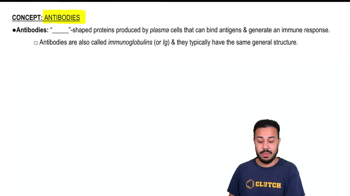
An antibody, also known as an immunoglobulin, is a specialized protein produced by B cells in response to antigens, which are foreign substances like pathogens. Antibodies play a crucial role in the immune system by recognizing and binding to specific antigens, marking them for destruction or neutralization.
Recommended video:
0:48
Antibodies

Antibody Structure

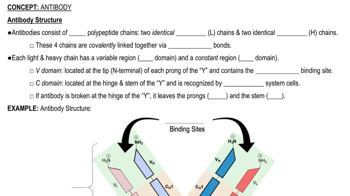
An antibody monomer typically consists of four polypeptide chains: two heavy chains and two light chains. These chains are linked by disulfide bonds, forming a Y-shaped structure. The tips of the Y contain variable regions that bind to specific antigens, while the stem of the Y contains constant regions that determine the antibody's class and effector functions.
Recommended video:
5:40
Antibody Structure

Variable and Constant Regions

The variable regions of an antibody are located at the tips of the Y-shaped structure and are responsible for antigen specificity, allowing the antibody to recognize and bind to a unique antigen. In contrast, the constant regions are located in the stem of the Y and are identical across antibodies of the same class, playing a role in mediating immune responses and interactions with other immune cells.
Recommended video:
Guided course
04:21
The 9 Abdominopelvic Regions