Ch. 25 The Urinary System
Chapter 24, Problem 19

Explain the important differences between blood plasma and glomerular filtrate, and relate the differences to the structure of the filtration membrane.

Verified step by step guidance
1
Begin by defining blood plasma as the liquid component of blood that contains water, ions, nutrients, proteins (such as albumin and globulins), and other solutes, while glomerular filtrate is the fluid that passes through the filtration membrane into the Bowman's capsule, initially similar to plasma but without most proteins.
Explain that the filtration membrane in the glomerulus consists of three layers: the fenestrated endothelium of glomerular capillaries, the basement membrane, and the podocyte layer with filtration slits, which together act as a selective barrier.
Describe how the fenestrated endothelium allows most plasma components to pass but restricts blood cells, the basement membrane blocks large proteins due to its dense matrix and negative charge, and the podocyte filtration slits further restrict large molecules.
Relate these structural features to the composition differences: glomerular filtrate contains water, ions, glucose, amino acids, and small solutes similar to plasma but lacks most plasma proteins and blood cells, which are retained in the bloodstream.
Conclude by emphasizing that these differences are crucial for kidney function, as the filtrate provides a protein-free fluid for further processing in the nephron, while plasma proteins remain in the blood to maintain oncotic pressure and other physiological roles.

Verified video answer for a similar problem:

This video solution was recommended by our tutors as helpful for the problem above.
Video duration:
2m
Was this helpful?

Key Concepts

Here are the essential concepts you must grasp in order to answer the question correctly.

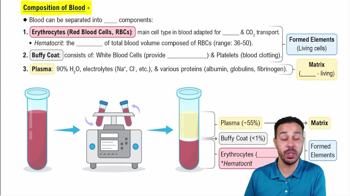
Composition of Blood Plasma

Blood plasma is the liquid component of blood, containing water, electrolytes, nutrients, hormones, proteins (such as albumin and globulins), and waste products. It serves as a transport medium for cells and substances throughout the body. Understanding its composition is essential to compare it with glomerular filtrate.
Recommended video:
7:49
Composition of Blood

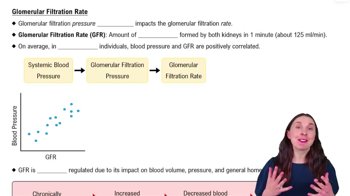
Glomerular Filtrate Composition

Glomerular filtrate is the fluid filtered from blood plasma through the glomerular filtration membrane into the nephron. It contains water, ions, glucose, amino acids, and small molecules but lacks most plasma proteins and blood cells. This selective filtration is key to kidney function and urine formation.
Recommended video:
3:15
Glomerular Filtration Rate

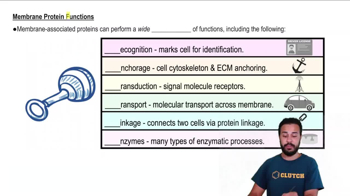
Structure and Function of the Filtration Membrane

The filtration membrane consists of fenestrated endothelium, basement membrane, and podocyte slit diaphragms. It acts as a size- and charge-selective barrier, allowing small molecules to pass while restricting large proteins and cells. This structural feature explains the differences between blood plasma and glomerular filtrate.
Recommended video:
03:54
Membrane Protein Functions