Pearson+ LogoPearson+ Logo
Ch. 25 The Urinary System
Marieb - Human Anatomy & Physiology 7th Edition
Elaine N. Marieb, Katja Hoehn7th EditionHuman Anatomy & PhysiologyISBN: 9780805359091Not the one you use?Change textbook
Chapter 24, Problem 7

Tubular reabsorption
a. Of glucose and many other substances is a Tm - limited active transport process
b. Of chloride is always linked to the passive transport of Na⁺
c. Is the movement of substances from the blood into the nephron
d. Of sodium occurs only in the proximal tubule

Verified step by step guidance
1
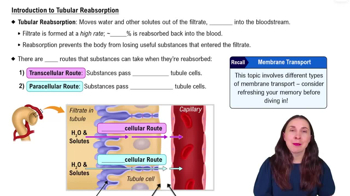
Step 1: Understand the concept of tubular reabsorption. Tubular reabsorption is the process by which substances are moved from the filtrate in the nephron back into the blood, primarily occurring in the proximal tubule but also in other parts of the nephron.
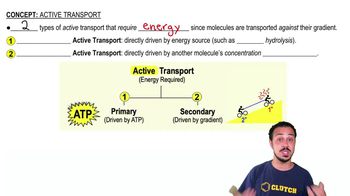
Step 2: Analyze option (a): Tubular reabsorption of glucose and many other substances is a T\_m-limited active transport process. This means there is a maximum transport rate (T\_m) due to the saturation of carrier proteins involved in active transport.
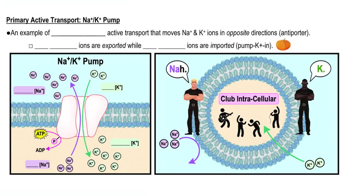
Step 3: Analyze option (b): Reabsorption of chloride ions (Cl⁻) is often linked to the passive transport of sodium ions (Na⁺) because sodium reabsorption creates an electrochemical gradient that facilitates chloride movement, often passively following sodium.
Step 4: Analyze option (c): Tubular reabsorption is the movement of substances from the nephron filtrate back into the blood, not from the blood into the nephron. Movement from blood into the nephron is secretion, the opposite process.
Step 5: Analyze option (d): Sodium reabsorption occurs not only in the proximal tubule but also in other parts of the nephron such as the loop of Henle, distal tubule, and collecting duct, though the majority occurs in the proximal tubule.

Verified video answer for a similar problem:

This video solution was recommended by our tutors as helpful for the problem above.
Video duration:
3m
Was this helpful?

Key Concepts

Here are the essential concepts you must grasp in order to answer the question correctly.

Tubular Reabsorption

Tubular reabsorption is the process by which substances are moved from the filtrate in the nephron back into the blood. It primarily occurs in the proximal tubule but also in other parts of the nephron. This process is essential for reclaiming valuable solutes like glucose, sodium, and water to maintain body fluid balance.
Recommended video:
4:06
Introduction to Tubular Reabsorption

Transport Maximum (Tm) and Active Transport

Transport maximum (Tm) refers to the maximum rate at which a substance can be reabsorbed due to limited carrier proteins. Active transport requires energy to move substances against their concentration gradient, such as glucose reabsorption in the proximal tubule, which is Tm-limited and saturable.
Recommended video:
02:37
Active Transport

Coupled Transport of Ions (Na⁺ and Cl⁻)

The reabsorption of chloride ions often occurs passively and is linked to the active transport of sodium ions. Sodium reabsorption creates an electrochemical gradient that drives chloride movement, maintaining electroneutrality and facilitating efficient salt and water reabsorption.
Recommended video:
06:57
Primary Active Transport: Na+/K+ Pump