Pearson+ LogoPearson+ Logo
Ch. 6 Bones and Skeletal Tissues
Marieb - Human Anatomy & Physiology 7th Edition
Elaine N. Marieb, Katja Hoehn7th EditionHuman Anatomy & PhysiologyISBN: 9780805359091Not the one you use?Change textbook
Chapter 6, Problem 11

A bone with approximately the same width, length, and height is most likely:
a. A long bone
b. A short bone
c. A flat bone
d. An irregular bone

Verified step by step guidance
1
Step 1: Understand the classification of bones based on their shapes and dimensions. Bones are generally categorized as long, short, flat, or irregular bones.
Step 2: Recall that long bones are characterized by being longer than they are wide, typically found in limbs (e.g., femur, humerus).
Step 3: Recognize that short bones have approximately equal length, width, and height, giving them a cube-like shape. Examples include the bones in the wrist (carpals) and ankle (tarsals).
Step 4: Know that flat bones are thin and often curved, providing protection and broad surfaces for muscle attachment (e.g., skull bones, ribs).
Step 5: Understand that irregular bones have complex shapes that do not fit into the other categories, such as vertebrae and some facial bones.

Verified video answer for a similar problem:

This video solution was recommended by our tutors as helpful for the problem above.
Video duration:
2m
Was this helpful?

Key Concepts

Here are the essential concepts you must grasp in order to answer the question correctly.

Bone Classification by Shape

Bones are categorized based on their shapes into long, short, flat, and irregular bones. This classification helps in understanding their functions and locations in the body.
Recommended video:
08:25
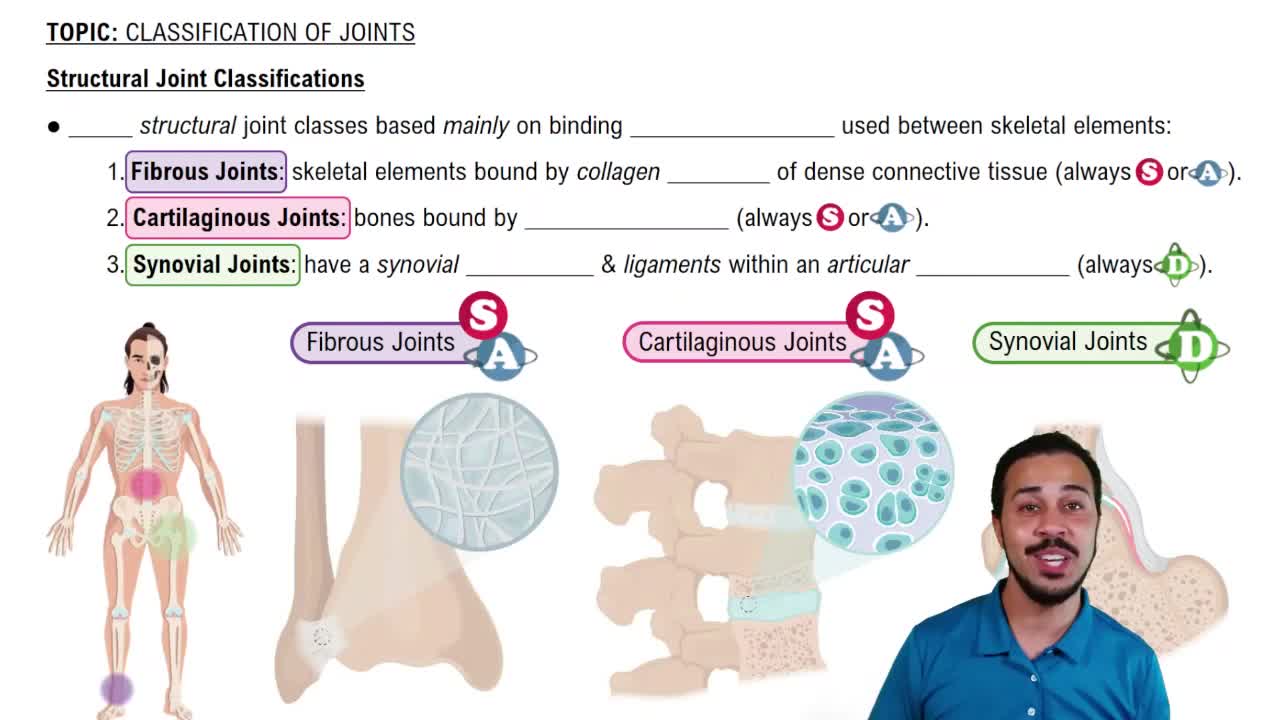
Structural Joint Classifications

Characteristics of Short Bones

Short bones are roughly cube-shaped, having approximately equal length, width, and height. They provide stability and support with limited movement, commonly found in the wrist and ankle.
Recommended video:
Guided course
2:58
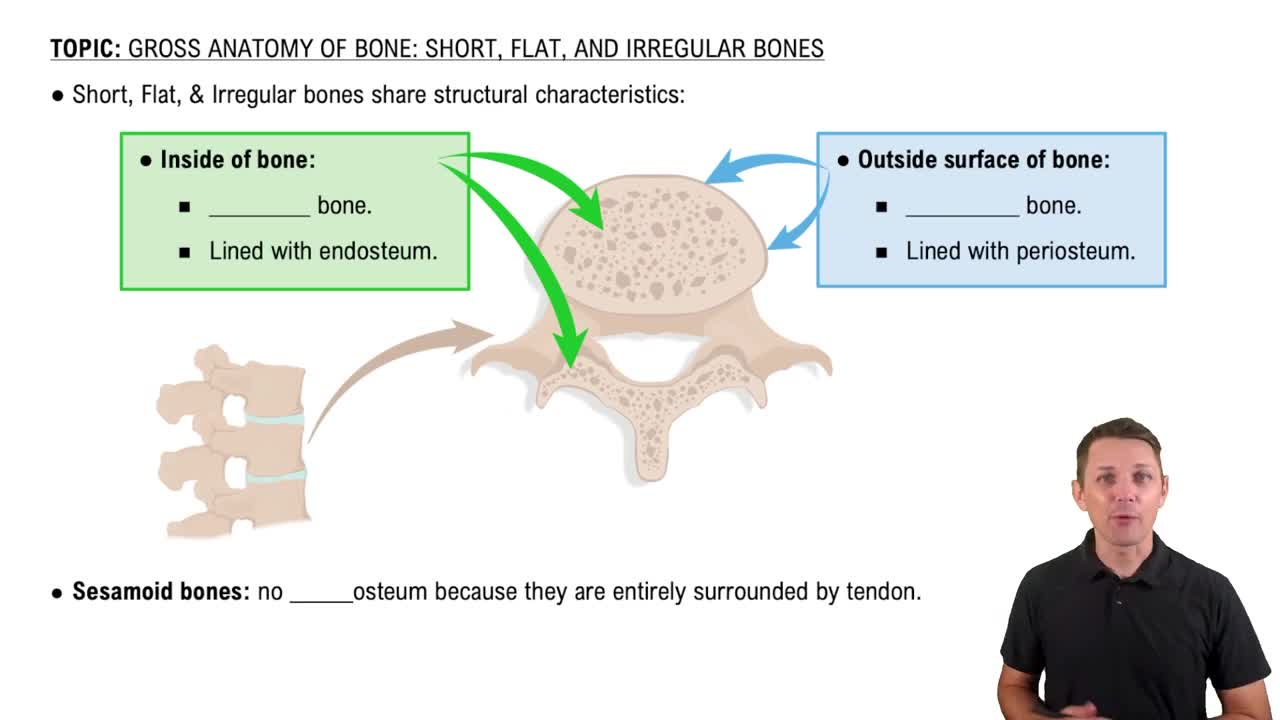
Short, Flat, and Irregular Bones

Differences Between Long, Flat, and Irregular Bones

Long bones are longer than they are wide, flat bones are thin and often curved, and irregular bones have complex shapes. Recognizing these differences aids in identifying bone types based on their dimensions.
Recommended video:
Guided course
2:58
Short, Flat, and Irregular Bones