
Pearson+ LogoPearson+ Logo
Ch. 1 - Can Science Cure the Common Cold?
Belk, Maier - Biology: Science for Life 6th Edition
Belk, Maier6th EditionBiology: Science for LifeISBN: 9780135214084Not the one you use?Change textbook
Chapter 1, Problem 10

A primary source of scientific results is ________.
a. The news media.
b. Anecdotes from others.
c. Articles in peer-reviewed journals.
d. The Internet.
e. All of the above.

Verified step by step guidance
1
Step 1: Understand the question by identifying the key term 'primary source of scientific results.' This refers to the most reliable and credible source for scientific findings.
Step 2: Evaluate each option provided in the question. Consider the credibility and reliability of each source in the context of scientific research.
Step 3: Recall that peer-reviewed journals are publications where scientific studies are reviewed by experts in the field before being published, ensuring accuracy and validity.
Step 4: Compare peer-reviewed journals to other options such as the news media, anecdotes, and the Internet, which may not undergo rigorous scientific validation processes.
Step 5: Conclude that articles in peer-reviewed journals are the most reliable primary source of scientific results, as they are specifically designed to disseminate validated scientific knowledge.

Verified video answer for a similar problem:

This video solution was recommended by our tutors as helpful for the problem above.
Video duration:
46s
Was this helpful?

Key Concepts

Here are the essential concepts you must grasp in order to answer the question correctly.

Primary Sources in Research

Primary sources are original materials that provide direct evidence or firsthand accounts of a subject. In scientific research, these include original research articles, experimental data, and clinical trials. They are crucial for validating findings and advancing knowledge, as they present unfiltered information directly from the researchers.
Recommended video:
Guided course
04:36
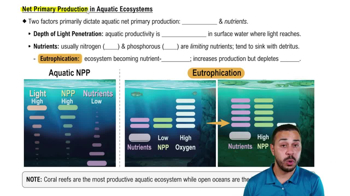
Primary Production in Aquatic Ecosystems

Peer-Reviewed Journals

Peer-reviewed journals are scholarly publications that require submitted articles to be evaluated by experts in the field before publication. This process ensures the quality, credibility, and reliability of the research presented. Articles in these journals are considered primary sources because they report original research findings and methodologies.
Recommended video:
Guided course
02:06
Review of Photosynthesis Example 1

Scientific Communication

Scientific communication refers to the ways in which scientific information is shared and disseminated. This includes various formats such as articles, presentations, and conferences. Understanding the distinction between primary and secondary sources is essential, as secondary sources often summarize or interpret primary research rather than presenting original data.
Recommended video:
Guided course
06:29
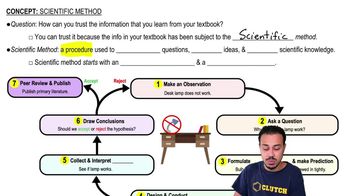
Scientific Method
Related Practice
Textbook Question

Control subjects in an experiment _________.

a. Should be similar in most ways to the experimental subjects.

b. Should not know whether they are in the control or experimental group.

c. Should have essentially the same interactions with the researchers as the experimental subjects.

d. Help eliminate alternative hypotheses that could explain experimental results.

e. All of the above.

1632
views
Textbook Question

An experiment in which neither the participants in the experiment nor the technicians collecting the data know which individuals are in the experimental group and which ones are in the control group is known as _________.

a. Controlled

b. Biased

c. Double-blind

d. Falsifiable

e. Unpredictable

1117
views
Textbook Question

A relationship between two factors, for instance, between outside temperature and the number of people with active colds in a population, is known as a(n) ________.

a. Significant result

b. Correlation

c. Hypothesis

d. Alternative hypothesis

e. Experimental test

846
views
Textbook Question

A story on your local news station reports that eating a 1-ounce square of milk chocolate each day reduces the risk of heart disease in rats and that this result is statistically significant. This means that ________.

a. People who eat milk chocolate are healthier than those who do not.

b. The difference between chocolate-eating and chocolate-abstaining rats in heart disease rates was greater than expected by chance.

c. Rats like milk chocolate.

d. Milk chocolate reduces the risk of heart disease.

e. Two ounces of milk chocolate per day is likely to be even better for heart health than 1 ounce.

825
views
Textbook Question

What features of the story on milk chocolate and heart health described in question 11 should cause you to consider the results less convincing?

a. The study was sponsored by a large milk chocolate manufacturer.

b. A total of 10 rats were used in the study.

c. The only difference between the rats was that human participants of the experimental group received chocolate along with their regular diets, and the human participants of the control group received no additional food.

d. The reporter notes that other studies indicate milk chocolate does not have a beneficial effect on heart health.

e. All of the above.

1006
views