Pearson+ LogoPearson+ Logo
Ch. 11 - Where Did We Come From?
Belk, Maier - Biology: Science for Life 6th Edition
Belk, Maier6th EditionBiology: Science for LifeISBN: 9780135214084Not the one you use?Change textbook
Chapter 11, Problem 1

What observations did Darwin make on the Galápagos Islands that helped convince him that evolution occurs?
a. The existence of animals that did not fit into Linnaeus's classification system
b. The similarities and differences among cacti and tortoises on the different islands
c. The presence of species he had seen on other tropical islands far from the Galápagos
d. The radioactive age of the rocks of the islands
e. Fossils of human ancestors

Verified step by step guidance
1
Darwin observed that the Galápagos Islands had unique species of plants and animals that were not found anywhere else in the world. This suggested that these species had adapted to their specific environments over time.
He noted that similar species, such as finches, showed variations in traits like beak shape and size depending on the island they inhabited. These differences were linked to the availability of food sources, indicating adaptation to local conditions.
Darwin also observed differences among cacti and tortoises on the different islands. For example, tortoises had distinct shell shapes depending on the island, which correlated with the type of vegetation available.
These observations led Darwin to hypothesize that species were not fixed and unchanging but could evolve over time through natural selection, where advantageous traits become more common in a population.
Darwin's observations of similarities and differences among species on the Galápagos Islands (such as finches, tortoises, and cacti) were critical in forming his theory of evolution by natural selection, as outlined in his book 'On the Origin of Species.'

Verified video answer for a similar problem:

This video solution was recommended by our tutors as helpful for the problem above.
Video duration:
1m
Was this helpful?

Key Concepts

Here are the essential concepts you must grasp in order to answer the question correctly.

Natural Selection

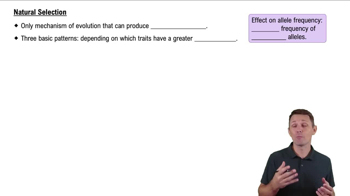
Natural selection is a fundamental mechanism of evolution proposed by Charles Darwin. It posits that individuals with traits better suited to their environment are more likely to survive and reproduce, passing those advantageous traits to the next generation. This process leads to gradual changes in species over time, as advantageous traits become more common within a population.
Recommended video:
04:43
Natural Selection

Adaptive Radiation

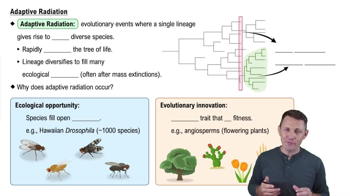
Adaptive radiation refers to the evolutionary process where organisms diversify rapidly into a variety of forms to adapt to different environments. This concept is exemplified by Darwin's observations of the finches on the Galápagos Islands, where different species evolved distinct beak shapes and sizes to exploit various food sources, illustrating how environmental pressures can shape species' adaptations.
Recommended video:
05:24
Adaptive Radiation

Biogeography

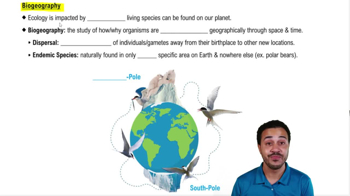
Biogeography is the study of the distribution of species and ecosystems in geographic space and through geological time. Darwin's observations of species on the Galápagos Islands, particularly their similarities to species on the mainland and other islands, provided critical evidence for evolution. It highlighted how geographic isolation can lead to speciation and the development of unique adaptations in different environments.
Recommended video: