
Pearson+ LogoPearson+ Logo
Ch. 13 - Understanding Race
Belk, Maier - Biology: Science for Life 6th Edition
Belk, Maier6th EditionBiology: Science for LifeISBN: 9780135214084Not the one you use?Change textbook
Chapter 13, Problem 10

Phylogenies are created based on the principle that all species descending from a recent common ancestor .
a. Should be identical
b. Should share characteristics that evolved in that ancestor
c. Should be found as fossils
d. Should have identical DNA sequences
e. Should be no more similar than species that are less closely related

Verified step by step guidance
1
Understand the concept of phylogenies: Phylogenies are diagrams that represent the evolutionary relationships among species, showing how they descend from common ancestors over time.
Recall the principle of shared derived characteristics: Species that share a recent common ancestor are expected to have traits that evolved in that ancestor. These traits are called 'shared derived characteristics' or 'synapomorphies.'
Eliminate incorrect options: a) Species are not identical because evolution introduces variation. c) Fossil evidence is not a requirement for constructing phylogenies. d) DNA sequences may not be identical due to mutations over time. e) Closely related species are expected to be more similar than distantly related ones.
Focus on the correct principle: The correct answer is based on the idea that species descending from a recent common ancestor share characteristics that evolved in that ancestor.
Conclude that the correct answer is b: Phylogenies are created based on the principle that species descending from a recent common ancestor should share characteristics that evolved in that ancestor.

Verified video answer for a similar problem:

This video solution was recommended by our tutors as helpful for the problem above.
Video duration:
2m
Was this helpful?

Key Concepts

Here are the essential concepts you must grasp in order to answer the question correctly.

Common Ancestry

Common ancestry is a fundamental concept in evolutionary biology, suggesting that all species share a recent common ancestor from which they have diverged over time. This principle underlies the construction of phylogenetic trees, which illustrate the evolutionary relationships among species based on shared traits and genetic information.
Recommended video:
06:39
Common Misconceptions

Shared Characteristics

Shared characteristics, or homologous traits, are features that are inherited from a common ancestor. These traits can include physical features, behaviors, or genetic sequences. The presence of these shared characteristics among species is crucial for understanding their evolutionary relationships and constructing accurate phylogenies.
Recommended video:
Guided course
09:26
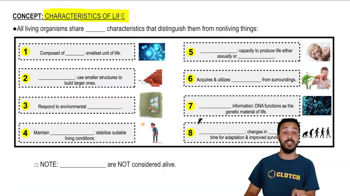
Characteristics of Life

Phylogenetic Trees

Phylogenetic trees are diagrams that represent the evolutionary relationships among various species based on their shared characteristics and genetic data. They illustrate how species are related through common ancestry and can help predict characteristics of unknown species based on their position in the tree. Understanding how to read and interpret these trees is essential for studying evolutionary biology.
Recommended video:
04:13
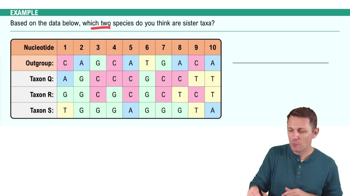
Building Phylogenetic Trees Example 2