Pearson+ LogoPearson+ Logo
Ch. 13 - Understanding Race
Belk, Maier - Biology: Science for Life 6th Edition
Belk, Maier6th EditionBiology: Science for LifeISBN: 9780135214084Not the one you use?Change textbook
Chapter 13, Problem 8

All of the following statements support the hypothesis that humans cannot be classified into biological races except:
a. There is more genetic diversity within a racial group than average differences between racial groups.
b. Alleles that are common in one population in a racial group may be uncommon in other populations of the same race.
c. Geneticists can use particular SNP alleles to identify the ancestral group(s) of any individual human.
d. There are no alleles found in all members of a given racial group.
e. There is genetic evidence of mixing among human populations occurring thousands of years ago until the present.

Verified step by step guidance
1
Step 1: Understand the question. The problem asks which statement does NOT support the hypothesis that humans cannot be classified into biological races. This means we are looking for the exception among the given statements.
Step 2: Review the hypothesis. The hypothesis states that humans cannot be classified into biological races. This is based on the idea that genetic variation does not align neatly with traditional racial categories.
Step 3: Analyze each statement: - (a) This supports the hypothesis because it highlights that genetic diversity within a racial group is greater than differences between groups. - (b) This supports the hypothesis because it shows that alleles vary even within populations of the same race. - (c) This does NOT support the hypothesis because it suggests that specific genetic markers (SNP alleles) can identify ancestral groups, implying some genetic distinction. - (d) This supports the hypothesis because it states that no allele is exclusive to a racial group. - (e) This supports the hypothesis because it shows evidence of genetic mixing, which blurs racial boundaries.
Step 4: Identify the exception. Based on the analysis, statement (c) is the exception because it implies that genetic markers can be used to distinguish ancestral groups, which could be interpreted as supporting the concept of biological races.
Step 5: Conclude that the correct answer is (c), as it does not align with the hypothesis that humans cannot be classified into biological races.

Verified video answer for a similar problem:

This video solution was recommended by our tutors as helpful for the problem above.
Video duration:
2m
Was this helpful?

Key Concepts

Here are the essential concepts you must grasp in order to answer the question correctly.

Genetic Diversity

Genetic diversity refers to the total number of genetic characteristics in the genetic makeup of a species. In the context of human populations, it highlights that there is often more genetic variation within so-called racial groups than between them, suggesting that traditional racial classifications do not accurately reflect biological differences.
Recommended video:
02:37
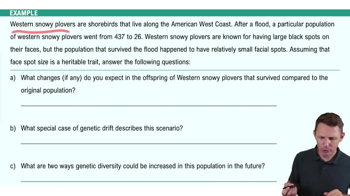
Genetic Drift Example 2

Single Nucleotide Polymorphisms (SNPs)

Single nucleotide polymorphisms (SNPs) are variations at a single position in a DNA sequence among individuals. Geneticists use SNPs to trace ancestry and population structure, but the presence of specific SNPs does not necessarily correlate with racial classifications, indicating that genetic traits are not confined to racial groups.
Recommended video:

Gene Flow and Mixing

Gene flow refers to the transfer of genetic material between populations, which can occur through migration and interbreeding. The historical mixing of human populations has led to a complex genetic landscape, undermining the concept of distinct biological races and supporting the idea that all humans share a common ancestry.
Recommended video:
01:43
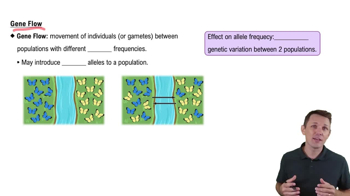
Gene Flow
Related Practice
Textbook Question

According to the most accepted scientific hypothesis about the origin of two new species from a single common ancestor, most new species arise when

a. Many mutations occur

b. Populations of the ancestral species are isolated from one another

c. There is no natural selection

d. A supernatural creator decides that two new species would be preferable to the old one

e. The ancestral species decides to evolve

1003
views
Textbook Question

For two populations of organisms to be considered separate biological species, they must be

a. Reproductively isolated from each other

b. Unable to produce living offspring

c. Physically very different from each other

d. A and C are correct

e. A, B, and C are correct

2934
views
Textbook Question

The biological definition of 'race' corresponds to all of the following except:

a. The genealogical species concept

b. The idea that subgroups within the same species can be distinguished from each other by ancestry

c. There is a natural hierarchy of groups within a species from 'lowest' to 'highest' forms

d. It should be possible to identify races on the basis of shared allele frequencies among populations

e. Races within a species are not reproductively isolated from each other.

986
views
Textbook Question

The similarity in skin color among different human populations appears to be primarily the result of:

a. Natural selection

b. Convergent evolution

c. Which biological race they belong to

d. A and B are correct

e. A, B, and C are correct

926
views
Textbook Question

The tendency of individuals to choose mates who are like themselves is called

a. Natural selection

b. Sexual selection

c. Assortative mating

d. The founder effect

e. Random mating

1225
views
Textbook Question

Phylogenies are created based on the principle that all species descending from a recent common ancestor .

a. Should be identical

b. Should share characteristics that evolved in that ancestor

c. Should be found as fossils

d. Should have identical DNA sequences

e. Should be no more similar than species that are less closely related

1748
views