Pearson+ LogoPearson+ Logo
Ch. 3 - Is It Possible to Supplement Your Way to Better Performance and Health?
Belk, Maier - Biology: Science for Life 6th Edition
Belk, Maier6th EditionBiology: Science for LifeISBN: 9780135214084Not the one you use?Change textbook
Chapter 3, Problem 10

Which of the following cannot pass through the membrane without the help of a membrane protein?
a. Carbon dioxide
b. Water
c. Oxygen
d. Charged molecules

Verified step by step guidance
1
Understand the structure of the cell membrane: The cell membrane is a phospholipid bilayer with hydrophobic (water-repelling) tails and hydrophilic (water-attracting) heads. This structure allows small, nonpolar molecules to pass through easily, while larger or charged molecules require assistance.
Analyze the properties of each molecule: Carbon dioxide (CO₂) and oxygen (O₂) are small, nonpolar molecules, which means they can diffuse directly through the lipid bilayer without assistance. Water (H₂O) is a small polar molecule, but it can pass through the membrane slowly due to its size and the presence of aquaporins (specialized water channels).
Consider the behavior of charged molecules: Charged molecules, such as ions, cannot pass through the hydrophobic core of the lipid bilayer because the charge interacts unfavorably with the nonpolar environment. These molecules require membrane proteins, such as channels or transporters, to cross the membrane.
Identify the key difference: The inability of charged molecules to pass through the membrane without assistance is due to their charge, which prevents them from diffusing through the hydrophobic lipid bilayer.
Conclude that charged molecules are the answer: Based on the analysis, charged molecules cannot pass through the membrane without the help of a membrane protein, unlike carbon dioxide, water, or oxygen.

Verified video answer for a similar problem:

This video solution was recommended by our tutors as helpful for the problem above.
Video duration:
40s
Was this helpful?

Key Concepts

Here are the essential concepts you must grasp in order to answer the question correctly.

Cell Membrane Structure

The cell membrane is primarily composed of a phospholipid bilayer, which creates a semi-permeable barrier. This structure allows small, nonpolar molecules like oxygen and carbon dioxide to pass freely, while larger or charged molecules require assistance from membrane proteins to cross the hydrophobic core of the membrane.
Recommended video:
Guided course
09:28
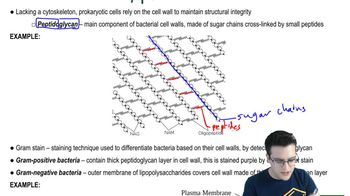
Prokaryotic Cell Structures 1

Membrane Proteins

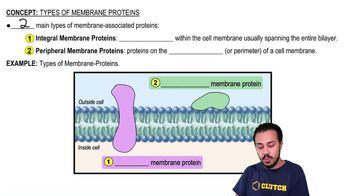
Membrane proteins are integral or peripheral proteins that facilitate the transport of substances across the cell membrane. They can act as channels or carriers for molecules that cannot diffuse freely through the lipid bilayer, such as ions and other charged molecules, which need specific binding sites to enter or exit the cell.
Recommended video:
Guided course
02:35
Types of Membrane Proteins

Selective Permeability

Selective permeability refers to the ability of the cell membrane to regulate the passage of substances in and out of the cell. This property ensures that essential molecules can enter while waste products and harmful substances are kept out, relying on both the lipid bilayer and membrane proteins to control what can pass through.
Recommended video:
04:43
Natural Selection