Pearson+ LogoPearson+ Logo
Ch. 4 - Body Weight and Health
Belk, Maier - Biology: Science for Life 6th Edition
Belk, Maier6th EditionBiology: Science for LifeISBN: 9780135214084Not the one you use?Change textbook
Chapter 4, Problem 6

What would happen if activation energy barriers didn't exist?
a. Substrates would not bind properly to enzymes.
b. Chemical reactions in the body would never occur.
c. Enzyme function would not be affected.
d. Metabolic reactions would proceed even if their products were not needed.

Verified step by step guidance
1
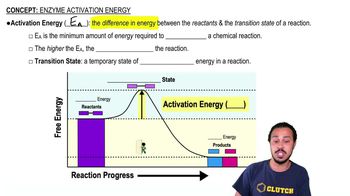
Understand the concept of activation energy: Activation energy is the minimum amount of energy required for a chemical reaction to proceed. It acts as a barrier that ensures reactions occur only under specific conditions.
Consider the role of enzymes: Enzymes lower the activation energy barrier, allowing reactions to occur more efficiently and under controlled conditions. Without activation energy barriers, enzymes would not need to regulate reactions.
Analyze the implications of no activation energy barriers: If activation energy barriers did not exist, chemical reactions could occur spontaneously and uncontrollably, regardless of whether the products were needed or not.
Evaluate the options provided: Option (a) is incorrect because substrate binding to enzymes is not directly related to activation energy barriers. Option (b) is incorrect because reactions would still occur, but uncontrollably. Option (c) is incorrect because enzyme function would be affected due to the lack of regulation. Option (d) is correct because metabolic reactions would proceed without the need for regulation or necessity of their products.
Conclude that activation energy barriers are essential for maintaining order and regulation in biological systems, ensuring that reactions occur only when needed and under appropriate conditions.

Verified video answer for a similar problem:

This video solution was recommended by our tutors as helpful for the problem above.
Video duration:
1m
Was this helpful?

Key Concepts

Here are the essential concepts you must grasp in order to answer the question correctly.

Activation Energy

Activation energy is the minimum energy required for a chemical reaction to occur. It acts as a barrier that must be overcome for reactants to transform into products. In biological systems, enzymes lower the activation energy, facilitating reactions that would otherwise proceed too slowly to sustain life.
Recommended video:
Guided course
04:18
Enzyme Activation Energy

Enzyme Function

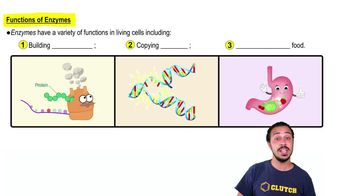
Enzymes are biological catalysts that speed up chemical reactions by lowering the activation energy. They bind to substrates, forming an enzyme-substrate complex, which stabilizes the transition state and allows the reaction to occur more efficiently. Without activation energy barriers, the specificity and regulation of enzyme function would be compromised.
Recommended video:
Guided course
02:32
Functions of Enzymes

Metabolic Reactions

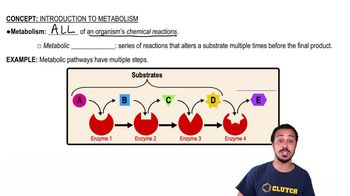
Metabolic reactions are the biochemical processes that occur within living organisms to maintain life, including catabolism and anabolism. These reactions are tightly regulated to ensure that they occur only when necessary. If activation energy barriers did not exist, metabolic pathways could run uncontrollably, leading to imbalances and potentially harmful consequences for the organism.
Recommended video:
Guided course
02:17
Introduction to Metabolism
Related Practice
Textbook Question
What are the reactants and products of cellular respiration?
4484
views
Textbook Question

Which of the following is a false statement regarding enzymes?

a. Enzymes are proteins that speed up metabolic reactions.

b. Enzymes have specific substrates.

c. Enzymes supply ATP to their substrates.

d. An enzyme may be used many times.

2685
views
Textbook Question

Enzymes speed up chemical reactions by ________.

a. Heating cells

b. Binding to substrates and placing stress on their bonds

c. Changing the shape of the cell

d. Supplying energy to the substrate

2162
views
Textbook Question

Cellular respiration involves ________.

a. The aerobic metabolism of sugars in the mitochondria by a process called glycolysis.

b. An electron transport chain that releases carbon dioxide.

c. The synthesis of ATP, which is driven by the rushing of protons through an ATP synthase.

d. Electron carriers that bring electrons to the citric acid cycle; e. the production of water during the citric acid cycle.

2210
views
Textbook Question

The electron transport chain ________.

a. Is located in the matrix of the mitochondrion.

b. Has the electronegative carbon dioxide at its base.

c. Is a series of nucleotides located in the inner mitochondrial membrane.

d. Is a series of enzymes located in the intermembrane space.

e. Moves electrons from protein to protein and moves protons from the matrix into the intermembrane space.

2829
views
1
rank
Textbook Question

Most of the energy in an ATP molecule is released ________.

a. During cellular respiration.

b. When the terminal phosphate group is hydrolyzed.

c. In the form of new nucleotides.

d. When it is transferred to NADH.

2091
views