Pearson+ LogoPearson+ Logo
Ch. 7 - Fertility
Belk, Maier - Biology: Science for Life 6th Edition
Belk, Maier6th EditionBiology: Science for LifeISBN: 9780135214084Not the one you use?Change textbook
Chapter 7, Problem 8

If humans have 23 pairs of chromosomes, each carrying hundreds to thousands of genes, roughly how many genes are there in the human genome?
a. 23
b. 46
c. 1000
d. 20,000
e. 200,000

Verified step by step guidance
1
Understand that humans have 23 pairs of chromosomes, which means there are 46 individual chromosomes in total (23 from each parent).
Each chromosome carries hundreds to thousands of genes. This means the total number of genes in the human genome is the sum of all the genes across all 46 chromosomes.
Recall that the human genome has been extensively studied, and it is estimated to contain approximately 20,000 to 25,000 genes in total.
Compare the given options to the estimated range of genes in the human genome. The correct answer should fall within this range.
Select the option that best matches the estimated number of genes in the human genome, which is approximately 20,000.

Verified video answer for a similar problem:

This video solution was recommended by our tutors as helpful for the problem above.
Video duration:
3m
Was this helpful?

Key Concepts

Here are the essential concepts you must grasp in order to answer the question correctly.

Chromosomes

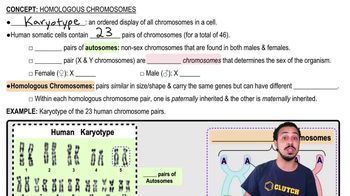
Chromosomes are long, thread-like structures made of DNA and proteins that contain genetic information. In humans, there are 23 pairs of chromosomes, totaling 46, with each chromosome carrying many genes. The arrangement and number of chromosomes are crucial for understanding genetic inheritance and variation.
Recommended video:
Guided course
08:09
Homologous Chromosomes

Genes

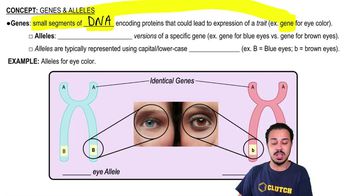
Genes are segments of DNA that encode instructions for building proteins, which perform various functions in the body. Each gene can vary in length and complexity, and the total number of genes in the human genome is estimated to be around 20,000 to 25,000. Understanding genes is essential for studying genetics, heredity, and biological functions.
Recommended video:
Guided course
05:02
Genes & Alleles

Human Genome

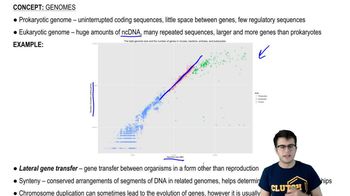
The human genome is the complete set of genetic information for humans, consisting of all the chromosomes and their associated genes. It contains the instructions necessary for the growth, development, and functioning of the human body. The study of the human genome has significant implications for medicine, genetics, and evolutionary biology.
Recommended video:
Guided course
05:30
Genomes and Genome Evolution
Related Practice
Textbook Question

An egg cell that is not fertilized follows which path?

a. Ovary, oviduct, uterus, cervix

b. Ovary, uterus, oviduct, cervix

c. Oviduct, ovary, cervix, uterus

d. Oviduct, ovary, uterus, cervix

e. Ovary, oviduct, cervix, uterus

2139
views
Textbook Question

Which of the following is mismatched?

a. Urethra: sperm passage

b. Testes: hormone production

c. Vas deferens: semen production

d. Seminiferous tubules: sperm production

813
views
Textbook Question

The production of gametes ________.

a. Begins at puberty in males and females.

b. Requires that the testes of males produce semen.

c. Results in the production of diploid cells from haploid cells.

d. Begins at puberty in females.

e. Produces sperm and eggs that carry half the number of chromosomes as nongametes.

1950
views
Textbook Question

Homologous pairs of chromosomes ________.

a. Are two different chromosomes attached to each other.

b. Are exact copies of one chromosome that are attached to each other.

c. Are separated from each other during meiosis I.

d. Are separated from each other during interphase.

e. Are chromosomes that carry different genes.

2884
views
Textbook Question

After telophase I of meiosis, each daughter cell is ________.

a. Diploid, and the chromosomes are composed of one double-stranded DNA molecule.

b. Diploid, and the chromosomes are composed of two sister chromatids.

c. Haploid, and the chromosomes are composed of one double-stranded DNA molecule.

d. Haploid, and the chromosomes are composed of two sister chromatids.

2720
views