Pearson+ LogoPearson+ Logo
Ch. 7 - Fertility
Belk, Maier - Biology: Science for Life 6th Edition
Belk, Maier6th EditionBiology: Science for LifeISBN: 9780135214084Not the one you use?Change textbook
Chapter 7, Problem 7

The production of gametes ________.
a. Begins at puberty in males and females.
b. Requires that the testes of males produce semen.
c. Results in the production of diploid cells from haploid cells.
d. Begins at puberty in females.
e. Produces sperm and eggs that carry half the number of chromosomes as nongametes.

Verified step by step guidance
1
Understand the concept of gametes: Gametes are reproductive cells (sperm in males and eggs in females) that carry half the number of chromosomes compared to somatic (non-reproductive) cells. This is because gametes are haploid, meaning they contain one set of chromosomes, while somatic cells are diploid, containing two sets of chromosomes.
Review the process of gametogenesis: Gametogenesis is the process by which gametes are formed. In males, this process is called spermatogenesis and occurs in the testes, while in females, it is called oogenesis and occurs in the ovaries.
Clarify the chromosome number: During gametogenesis, diploid cells undergo meiosis, a type of cell division that reduces the chromosome number by half, resulting in haploid gametes. This ensures that when fertilization occurs, the resulting zygote has the correct diploid chromosome number.
Examine the timing of gamete production: In males, spermatogenesis begins at puberty and continues throughout life. In females, oogenesis begins before birth, but the process pauses until puberty, when it resumes during the menstrual cycle.
Identify the correct answer: Based on the information above, gametes (sperm and eggs) are haploid cells that carry half the number of chromosomes as somatic cells. This aligns with option e, which states that gametes produce sperm and eggs that carry half the number of chromosomes as nongametes.

Verified video answer for a similar problem:

This video solution was recommended by our tutors as helpful for the problem above.
Video duration:
26s
Was this helpful?

Key Concepts

Here are the essential concepts you must grasp in order to answer the question correctly.

Gamete Production

Gamete production, or gametogenesis, is the biological process through which specialized cells called gametes (sperm in males and eggs in females) are produced. This process begins at puberty in both sexes, involving complex hormonal regulation and cellular division. In males, it occurs in the testes, while in females, it takes place in the ovaries.
Recommended video:
Guided course
04:36
Primary Production in Aquatic Ecosystems

Haploid and Diploid Cells

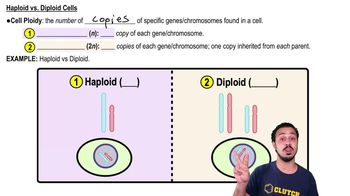
In humans, diploid cells contain two sets of chromosomes (one from each parent), while haploid cells contain only one set. Gametes are haploid, meaning they carry half the genetic information necessary for the formation of a new organism. During fertilization, two haploid gametes combine to form a diploid zygote, restoring the full chromosome number.
Recommended video:
Guided course
04:14
Haploid vs. Diploid Cells

Semen Production

Semen is a fluid that contains sperm cells and is produced in males during ejaculation. The production of semen involves the testes, which generate sperm, and accessory glands that contribute fluids to create semen. This process is essential for the delivery of sperm during reproduction, but it is distinct from the actual formation of gametes.
Recommended video:
Guided course
04:36
Primary Production in Aquatic Ecosystems
Related Practice
Textbook Question

A sperm cell follows which path?

a. Seminiferous tubules, epididymis, vas deferens, urethra

b. Urethra, vas deferens, seminiferous tubules, epididymis

c. Seminiferous tubules, vas deferens, epididymis, urethra

d. Epididymis, seminiferous tubules, vas deferens, urethra

e. Epididymis, vas deferens, seminiferous tubules, urethra

1846
views
Textbook Question

An egg cell that is not fertilized follows which path?

a. Ovary, oviduct, uterus, cervix

b. Ovary, uterus, oviduct, cervix

c. Oviduct, ovary, cervix, uterus

d. Oviduct, ovary, uterus, cervix

e. Ovary, oviduct, cervix, uterus

2139
views
Textbook Question

Which of the following is mismatched?

a. Urethra: sperm passage

b. Testes: hormone production

c. Vas deferens: semen production

d. Seminiferous tubules: sperm production

813
views
Textbook Question

If humans have 23 pairs of chromosomes, each carrying hundreds to thousands of genes, roughly how many genes are there in the human genome?

a. 23

b. 46

c. 1000

d. 20,000

e. 200,000

1745
views
Textbook Question

Homologous pairs of chromosomes ________.

a. Are two different chromosomes attached to each other.

b. Are exact copies of one chromosome that are attached to each other.

c. Are separated from each other during meiosis I.

d. Are separated from each other during interphase.

e. Are chromosomes that carry different genes.

2884
views
Textbook Question

After telophase I of meiosis, each daughter cell is ________.

a. Diploid, and the chromosomes are composed of one double-stranded DNA molecule.

b. Diploid, and the chromosomes are composed of two sister chromatids.

c. Haploid, and the chromosomes are composed of one double-stranded DNA molecule.

d. Haploid, and the chromosomes are composed of two sister chromatids.

2720
views