Pearson+ LogoPearson+ Logo
Ch. 8 - Does Testing Save Lives?
Belk, Maier - Biology: Science for Life 6th Edition
Belk, Maier6th EditionBiology: Science for LifeISBN: 9780135214084Not the one you use?Change textbook
Chapter 8, Problem 5

Sperm and eggs in humans always ________.
a. Each have two copies of every gene.
b. Each have one copy of every gene.
c. Each contain either all recessive alleles or all dominant alleles.
d. Are genetically identical to all other sperm or eggs produced by that person.
e. Each contain all of the genetic information from their producer.

Verified step by step guidance
1
Understand that sperm and eggs are gametes, which are specialized cells involved in sexual reproduction. Gametes are produced through a process called meiosis.
Recall that meiosis reduces the chromosome number by half, so that each gamete contains only one set of chromosomes (haploid), as opposed to the two sets (diploid) found in somatic cells.
Recognize that each chromosome in a gamete carries one copy of each gene, which is why gametes have one copy of every gene. This ensures that when sperm and egg combine during fertilization, the resulting zygote will have two copies of each gene (one from each parent).
Eliminate incorrect options: (a) is incorrect because gametes do not have two copies of every gene; (c) is incorrect because gametes contain a mix of alleles, not exclusively recessive or dominant; (d) is incorrect because gametes are genetically unique due to crossing over and independent assortment during meiosis; (e) is incorrect because gametes do not contain all genetic information from their producer, only half.
Conclude that the correct answer is (b), as sperm and eggs each have one copy of every gene, ensuring proper genetic contribution during fertilization.

Verified video answer for a similar problem:

This video solution was recommended by our tutors as helpful for the problem above.
Video duration:
2m
Was this helpful?

Key Concepts

Here are the essential concepts you must grasp in order to answer the question correctly.

Meiosis

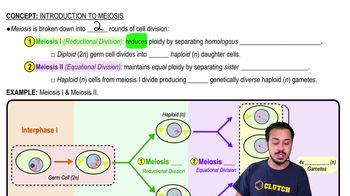
Meiosis is a specialized form of cell division that reduces the chromosome number by half, resulting in the production of gametes (sperm and eggs) with one copy of each chromosome. This process ensures genetic diversity through recombination and independent assortment, leading to gametes that are genetically distinct from one another and from the parent organism.
Recommended video:
Guided course
04:49
Meiosis I & Meiosis II

Haploidy

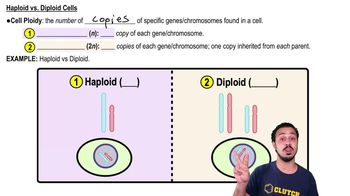
Haploidy refers to the condition of having a single set of chromosomes, which is characteristic of gametes in sexually reproducing organisms. In humans, sperm and eggs are haploid cells, containing one copy of each gene, which is crucial for maintaining the correct chromosome number upon fertilization when two haploid gametes combine to form a diploid zygote.
Recommended video:
Guided course
04:14
Haploid vs. Diploid Cells

Genetic Variation

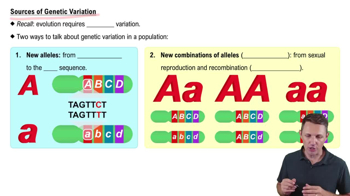
Genetic variation is the diversity in gene frequencies within a population, which arises from processes such as mutation, recombination during meiosis, and independent assortment. This variation is essential for evolution and adaptation, as it provides the raw material for natural selection to act upon, ensuring that offspring are not genetically identical to their parents or to each other.
Recommended video:
02:16
Sources of Genetic Variation
Related Practice
Textbook Question

Add labels to the figure that follows, which illustrates a portion of the human life cycle.

2136
views
Textbook Question

Which of the following statements correctly describe the relationship between genes and chromosomes?

a. Genes are chromosomes.

b. Chromosomes contain many genes.

c. Genes are made up of hundreds or thousands of chromosomes.

d. Genes are assorted independently during meiosis, but chromosomes are not.

e. More than one of the above is correct.

2362
views
Textbook Question

An allele is a ________.

a. Version of a gene

b. Dysfunctional gene

c. Protein

d. Spare copy of a gene

e. Phenotype

1620
views
Textbook Question

Scientists have recently developed a process by which a skin cell from a human can be triggered to develop into a human heart muscle cell. This is possible because ________.

a. Most cells in the human body contain the genetic instructions for making all types of human cells.

b. A skin cell is produced when all genes in the cell are expressed; turning off some genes in the cell results in a heart cell.

c. Scientists can add new genes to old cells to make them take different forms.

d. A skin cell expresses only recessive alleles, so it can be triggered to produce dominant heart cell alleles.

e. It is easy to mutate the genes in skin cells to produce the alleles required for other cell types.

1711
views
Textbook Question

What is the physical basis for the independent assortment of alleles into offspring?

a. There are chromosome divisions during gamete production.

b. Homologous chromosome pairs are separated during gamete production.

c. Sperm and eggs are produced by different sexes.

d. Each gene codes for more than one protein.

e. The instruction manual for producing a human is incomplete.

1478
views
Textbook Question

Among heritable diseases, which genotype can be present in an individual without causing a disease phenotype in that individual?

a. Heterozygous for a dominant disease

b. Homozygous for a dominant disease

c. Heterozygous for recessive disease

d. Homozygous for a recessive disease

e. All of the above

1164
views