Pearson+ LogoPearson+ Logo
Ch. 8 - Does Testing Save Lives?
Belk, Maier - Biology: Science for Life 6th Edition
Belk, Maier6th EditionBiology: Science for LifeISBN: 9780135214084Not the one you use?Change textbook
Chapter 8, Problem 3

Which of the following statements correctly describe the relationship between genes and chromosomes?
a. Genes are chromosomes.
b. Chromosomes contain many genes.
c. Genes are made up of hundreds or thousands of chromosomes.
d. Genes are assorted independently during meiosis, but chromosomes are not.
e. More than one of the above is correct.

Verified step by step guidance
1
Understand the basic definitions: Genes are segments of DNA that code for specific proteins or traits, while chromosomes are structures within cells that contain DNA and proteins. Chromosomes house many genes.
Analyze statement (a): 'Genes are chromosomes.' This is incorrect because genes are smaller units located on chromosomes, not equivalent to chromosomes themselves.
Analyze statement (b): 'Chromosomes contain many genes.' This is correct because chromosomes are composed of DNA, and within this DNA are multiple genes arranged linearly.
Analyze statement (c): 'Genes are made up of hundreds or thousands of chromosomes.' This is incorrect because genes are segments of DNA, and chromosomes are larger structures that contain many genes, not the other way around.
Analyze statement (d): 'Genes are assorted independently during meiosis, but chromosomes are not.' This is incorrect because both genes and chromosomes are assorted independently during meiosis due to the process of independent assortment and crossing over.

Verified video answer for a similar problem:

This video solution was recommended by our tutors as helpful for the problem above.
Video duration:
2m
Was this helpful?

Key Concepts

Here are the essential concepts you must grasp in order to answer the question correctly.

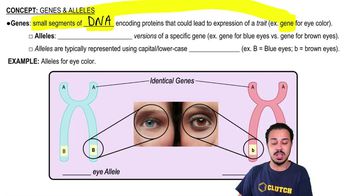
Genes

Genes are segments of DNA that contain the instructions for building proteins, which are essential for the structure and function of living organisms. Each gene occupies a specific location on a chromosome and can vary in size and function. They are the basic units of heredity, passed from parents to offspring, influencing traits and characteristics.
Recommended video:
Guided course
05:02
Genes & Alleles

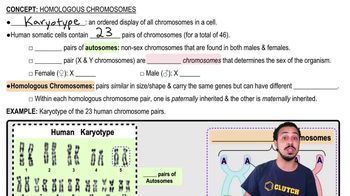
Chromosomes

Chromosomes are long, thread-like structures made of DNA and proteins that organize and package genetic material within the cell nucleus. Humans typically have 46 chromosomes, arranged in 23 pairs, with one set inherited from each parent. Each chromosome can contain hundreds to thousands of genes, making them crucial for genetic diversity and inheritance.
Recommended video:
Guided course
08:09
Homologous Chromosomes

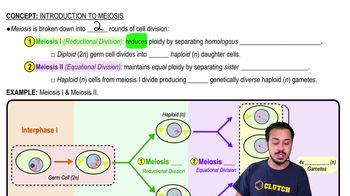
Meiosis

Meiosis is a specialized type of cell division that reduces the chromosome number by half, resulting in the formation of gametes (sperm and eggs). During meiosis, genes are assorted independently, meaning that the distribution of alleles into gametes occurs randomly. This process contributes to genetic variation in offspring, while chromosomes themselves remain intact as structures.
Recommended video:
Guided course
04:49
Meiosis I & Meiosis II