Ch. 7 - Logarithmic, Exponential Functions, and Hyperbolic Functions
Briggs - Calculus: Early Transcendentals 3rd Edition
Briggs3rd EditionCalculus: Early TranscendentalsISBN: 9780136847243Not the one you use?Change textbook
Chapter 7, Problem 7.2.20

15–20. Designing exponential growth functions Complete the following steps for the given situation.


a. Find the rate constant k and use it to devise an exponential growth function that fits the given data.
b. Answer the accompanying question.


Cell growth The number of cells in a tumor doubles every 6 weeks starting with 8 cells. After how many weeks does the tumor have 1500 cells?

Verified step by step guidance
1
Step 1: Identify the general form of the exponential growth function, which is given by \(N(t) = N_0 e^{k t}\), where \(N(t)\) is the number of cells at time \(t\), \(N_0\) is the initial number of cells, \(k\) is the growth rate constant, and \(t\) is the time in weeks.
Step 2: Use the information that the number of cells doubles every 6 weeks to find the rate constant \(k\). Since doubling means \(N(6) = 2 N_0\), substitute into the formula: \(2 N_0 = N_0 e^{k \times 6}\). Simplify this to \$2 = e^{6k}$.
Step 3: Solve for \(k\) by taking the natural logarithm of both sides: \(\ln(2) = 6k\), which gives \(k = \frac{\ln(2)}{6}\).
Step 4: Write the exponential growth function using the initial number of cells \(N_0 = 8\) and the rate constant \(k\): \(N(t) = 8 e^{\frac{\ln(2)}{6} t}\).
Step 5: To find the time \(t\) when the tumor has 1500 cells, set \(N(t) = 1500\) and solve for \(t\): \(1500 = 8 e^{\frac{\ln(2)}{6} t}\). Divide both sides by 8, then take the natural logarithm to isolate \(t\): \(\ln\left(\frac{1500}{8}\right) = \frac{\ln(2)}{6} t\), and finally solve for \(t\) by multiplying both sides by \(\frac{6}{\ln(2)}\).

Verified video answer for a similar problem:

This video solution was recommended by our tutors as helpful for the problem above.
Video duration:
3m
Was this helpful?

Key Concepts

Here are the essential concepts you must grasp in order to answer the question correctly.

Exponential Growth Function

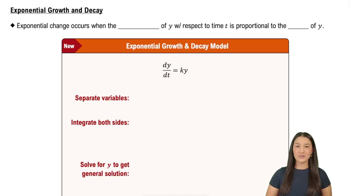
An exponential growth function models quantities that increase by a constant percentage rate over equal time intervals. It is generally expressed as N(t) = N_0 * e^(kt), where N_0 is the initial amount, k is the growth rate constant, and t is time. This function is essential for describing processes like cell growth where the quantity doubles periodically.
Recommended video:
09:29
Exponential Growth & Decay

Rate Constant (k) in Exponential Growth

The rate constant k determines how quickly the quantity grows in an exponential model. It can be found using known data points and the formula k = (ln(final amount / initial amount)) / time. Calculating k allows us to create a precise growth function that fits the given data, such as doubling time in cell growth.
Recommended video:
09:29
Exponential Growth & Decay

Solving for Time in Exponential Equations

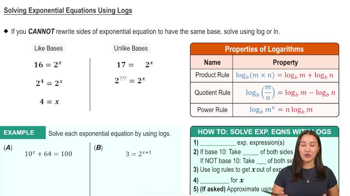
To find the time when a quantity reaches a certain value, we solve the exponential equation for t. This involves isolating t by taking the natural logarithm of both sides and rearranging the formula. This step is crucial for answering questions like determining when the tumor reaches 1500 cells.
Recommended video:
5:47
Solving Exponential Equations Using Logs