Ch. 2 - Limits
Briggs - Calculus: Early Transcendentals 3rd Edition
Briggs3rd EditionCalculus: Early TranscendentalsISBN: 9780136847243Not the one you use?Change textbook
Chapter 2, Problem 2.6.17

Determine whether the following functions are continuous at a. Use the continuity checklist to justify your answer. 
f(x)=2x^2+3x+1 / x^2+5x; a=−5

Verified step by step guidance
1
Identify the function: \( f(x) = \frac{2x^2 + 3x + 1}{x^2 + 5x} \).
Check if \( f(x) \) is defined at \( x = -5 \). Substitute \( x = -5 \) into the denominator: \( (-5)^2 + 5(-5) = 25 - 25 = 0 \). The function is not defined at \( x = -5 \) because the denominator is zero.
Since \( f(x) \) is not defined at \( x = -5 \), it is not continuous at \( x = -5 \).
For a function to be continuous at a point \( a \), it must be defined at \( a \), the limit as \( x \) approaches \( a \) must exist, and the limit must equal \( f(a) \).
Since \( f(x) \) is not defined at \( x = -5 \), it fails the first condition of the continuity checklist, confirming it is not continuous at \( x = -5 \).

Verified video answer for a similar problem:

This video solution was recommended by our tutors as helpful for the problem above.
Video duration:
3m
Was this helpful?

Key Concepts

Here are the essential concepts you must grasp in order to answer the question correctly.

Continuity of Functions

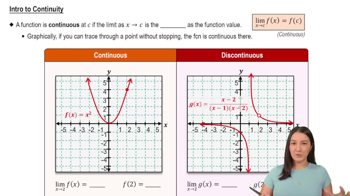
A function is continuous at a point 'a' if three conditions are met: the function is defined at 'a', the limit of the function as 'x' approaches 'a' exists, and the limit equals the function's value at 'a'. This concept is fundamental in calculus as it ensures that there are no breaks, jumps, or holes in the graph of the function at that point.
Recommended video:
05:34
Intro to Continuity

Limit of a Function

The limit of a function describes the behavior of the function as the input approaches a certain value. For continuity, it is essential to evaluate the limit from both the left and right sides of 'a'. If both limits agree and equal the function's value at 'a', the function is continuous at that point.
Recommended video:
06:11
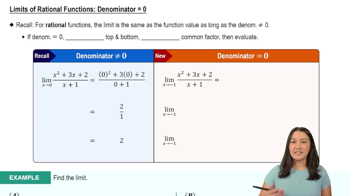
Limits of Rational Functions: Denominator = 0

Rational Functions

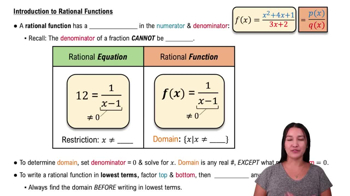
Rational functions are ratios of polynomials, and their continuity can be affected by points where the denominator equals zero. In this case, we must check if the function is defined at 'a' and if the limit exists. If the denominator is zero at 'a', the function is not continuous there, necessitating careful analysis of the function's behavior around that point.
Recommended video:
6:04
Intro to Rational Functions