

Ch. 4 - Applications of Derivatives
Hass - Thomas' Calculus 15th Edition
Hass15th EditionThomas' CalculusISBN: 9780137616077Not the one you use?Change textbook
Chapter 4, Problem 4.2

Finding Extreme Values
In Exercises 1–10, find the extreme values (absolute and local) of the function over its natural domain, and where they occur.


y = 𝓍³ ― 2𝓍 + 4

Verified step by step guidance
1
First, find the derivative of the function \( y = x^3 - 2x + 4 \) to determine the critical points. The derivative is \( y' = 3x^2 - 2 \).
Set the derivative equal to zero to find the critical points: \( 3x^2 - 2 = 0 \). Solve for \( x \) to find the critical points.
Solve the equation \( 3x^2 - 2 = 0 \) by isolating \( x^2 \): \( x^2 = \frac{2}{3} \). Then, take the square root of both sides to find \( x = \pm \sqrt{\frac{2}{3}} \).
Evaluate the second derivative \( y'' = 6x \) to determine the concavity at each critical point. Substitute each critical point into the second derivative to determine if it is a local minimum or maximum.
Finally, evaluate the original function \( y = x^3 - 2x + 4 \) at the critical points and endpoints of the domain (if any) to find the absolute extreme values. Compare these values to determine the absolute maximum and minimum.

Verified video answer for a similar problem:

This video solution was recommended by our tutors as helpful for the problem above.
Video duration:
5m
Was this helpful?

Key Concepts

Here are the essential concepts you must grasp in order to answer the question correctly.

Critical Points

Critical points of a function occur where its derivative is zero or undefined. These points are potential locations for local extrema. To find them, compute the derivative of the function and solve for values of x where the derivative equals zero or does not exist. For the function y = x³ - 2x + 4, find the derivative and solve for x to identify critical points.
Recommended video:
04:50
Critical Points

First Derivative Test

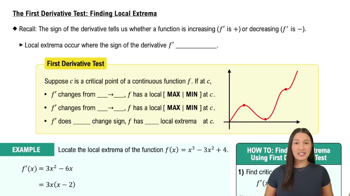
The First Derivative Test helps determine whether a critical point is a local maximum, minimum, or neither. By analyzing the sign of the derivative before and after the critical point, one can infer the behavior of the function. If the derivative changes from positive to negative, the point is a local maximum; if it changes from negative to positive, it's a local minimum.
Recommended video:
07:09
The First Derivative Test: Finding Local Extrema

Second Derivative Test

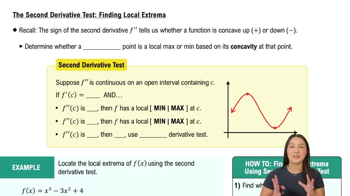
The Second Derivative Test provides another method to classify critical points. If the second derivative at a critical point is positive, the function has a local minimum there; if negative, a local maximum. If the second derivative is zero, the test is inconclusive. For y = x³ - 2x + 4, compute the second derivative to apply this test at the critical points.
Recommended video:
06:02
The Second Derivative Test: Finding Local Extrema