Ch. 8 - Integration Techniques
Briggs - Calculus: Early Transcendentals 3rd Edition
Briggs3rd EditionCalculus: Early TranscendentalsISBN: 9780136847243Not the one you use?Change textbook
Chapter 8, Problem 8.4.65

60–69. Completing the square Evaluate the following integrals.
65. ∫[1/2 to (√2 + 3)/(2√2)] dx / (8x² - 8x + 11)

Verified step by step guidance
1
Start by examining the quadratic expression in the denominator: \(8x^{2} - 8x + 11\). To simplify the integral, we want to complete the square for this quadratic.
Factor out the coefficient of \(x^{2}\) from the first two terms: \(8(x^{2} - x) + 11\).
Complete the square inside the parentheses: take half of the coefficient of \(x\), which is \(-1\), divide by 2 to get \(-\frac{1}{2}\), then square it to get \(\left(-\frac{1}{2}\right)^{2} = \frac{1}{4}\). Add and subtract this inside the parentheses:
\(8\left(x^{2} - x + \frac{1}{4} - \frac{1}{4}\right) + 11 = 8\left(\left(x - \frac{1}{2}\right)^{2} - \frac{1}{4}\right) + 11\).
Distribute the 8 and simplify the constant terms: \(8\left(x - \frac{1}{2}\right)^{2} - 8 \times \frac{1}{4} + 11 = 8\left(x - \frac{1}{2}\right)^{2} - 2 + 11 = 8\left(x - \frac{1}{2}\right)^{2} + 9\).
Rewrite the integral using this completed square form: \(\int_{\frac{1}{2}}^{\frac{\sqrt{2} + 3}{2\sqrt{2}}} \frac{dx}{8\left(x - \frac{1}{2}\right)^{2} + 9}\). Next, factor out the 9 to express the denominator in a form suitable for an arctangent substitution.

Verified video answer for a similar problem:

This video solution was recommended by our tutors as helpful for the problem above.
Video duration:
3m
Was this helpful?

Key Concepts

Here are the essential concepts you must grasp in order to answer the question correctly.

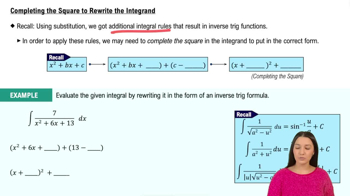
Completing the Square

Completing the square is a technique used to rewrite quadratic expressions in the form ax² + bx + c as a perfect square plus or minus a constant. This simplifies integration by transforming the denominator into a form that matches standard integral formulas, especially those involving inverse trigonometric functions.
Recommended video:
05:22
Completing the Square to Rewrite the Integrand

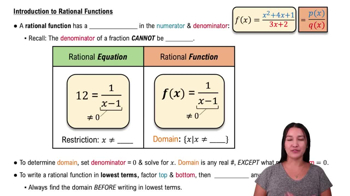
Integration of Rational Functions

Integrating rational functions often involves algebraic manipulation such as factoring or completing the square. Recognizing the form of the denominator helps in applying appropriate substitution or standard integral results, enabling the evaluation of integrals that might otherwise be complex.
Recommended video:
6:04
Intro to Rational Functions

Definite Integrals and Limits of Integration

Definite integrals calculate the net area under a curve between two specific points. Understanding how to apply the limits after finding the antiderivative is crucial, as it involves substituting the upper and lower bounds correctly to find the exact value of the integral.
Recommended video:
05:43
Definition of the Definite Integral