

Ch. 6 - Applications of Integration
Briggs - Calculus: Early Transcendentals 3rd Edition
Briggs3rd EditionCalculus: Early TranscendentalsISBN: 9780136847243Not the one you use?Change textbook
Chapter 6, Problem 6.1.10d

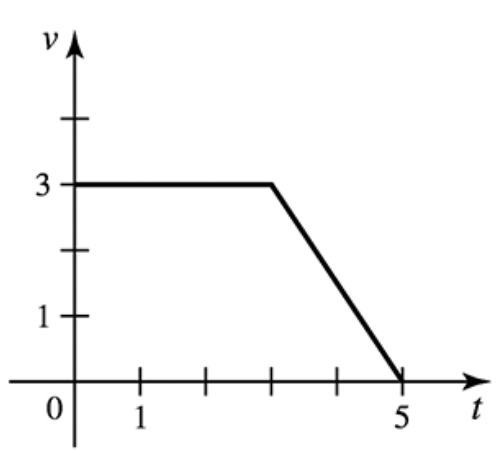
9–10. Velocity graphs The figures show velocity functions for motion along a line. Assume the motion begins with an initial position of s(0)=0. Determine the following.
img
d. A piecewise function for s(t)

Verified step by step guidance
1
Step 1: Understand that the velocity function \(v(t)\) is the derivative of the position function \(s(t)\), so \(s(t)\) can be found by integrating \(v(t)\) with respect to \(t\).
Step 2: Identify the piecewise definition of \(v(t)\) from the graph. For \(0 \leq t \leq 3\), \(v(t) = 3\). For \(3 < t \leq 5\), \(v(t)\) decreases linearly from 3 to 0, so find the equation of the line connecting points \((3,3)\) and \((5,0)\).
Step 3: Write the velocity function as a piecewise function: \(v(t) = \begin{cases} 3 & 0 \leq t \leq 3 \\ m t + b & 3 < t \leq 5 \end{cases}\) where \(m\) and \(b\) are the slope and intercept of the line segment from \(t=3\) to \(t=5\).
Step 4: Integrate each piece of \(v(t)\) to find \(s(t)\). For \(0 \leq t \leq 3\), integrate the constant velocity 3 to get \(s(t) = 3t + C_1\). Use the initial condition \(s(0) = 0\) to find \(C_1\).
Step 5: For \(3 < t \leq 5\), integrate the linear velocity function \(m t + b\) to get \(s(t) = \frac{m}{2} t^2 + b t + C_2\). Use continuity of \(s(t)\) at \(t=3\) to solve for \(C_2\).

Verified video answer for a similar problem:

This video solution was recommended by our tutors as helpful for the problem above.
Video duration:
5m
Was this helpful?

Key Concepts

Here are the essential concepts you must grasp in order to answer the question correctly.

Relationship Between Velocity and Position

Velocity is the derivative of position with respect to time, meaning that the position function s(t) can be found by integrating the velocity function v(t). Given an initial position s(0), integrating v(t) over time gives the displacement from the initial position.
Recommended video:
06:29
Derivatives Applied To Velocity

Piecewise Functions

A piecewise function is defined by different expressions over different intervals of the domain. In this problem, the velocity graph changes behavior at t=3 and t=5, so the position function s(t) must be expressed as a piecewise integral of v(t) over these intervals.
Recommended video:
05:36
Piecewise Functions

Definite Integration and Area Under the Curve

The position change over an interval is the definite integral of velocity over that interval, which corresponds to the area under the velocity curve. Calculating these areas for each piece of the velocity graph allows us to construct the position function s(t).
Recommended video:
05:43
Definition of the Definite Integral