

Ch. 3 - Derivatives
Briggs - Calculus: Early Transcendentals 3rd Edition
Briggs3rd EditionCalculus: Early TranscendentalsISBN: 9780136847243Not the one you use?Change textbook
Chapter 3, Problem 3.8.42b

Surface area of a cone The lateral surface area of a cone of radius r and height h (the surface area excluding the base) is A = πr√r²+h².
b. Evaluate this derivative when r=30 and h=40.

Verified step by step guidance
1
First, identify the formula for the lateral surface area of a cone, which is given as A = πr√(r² + h²).
To find the derivative of A with respect to r, apply the chain rule. The expression inside the square root, r² + h², is a function of r, so differentiate it with respect to r.
The derivative of r² with respect to r is 2r, and since h is a constant, the derivative of h² with respect to r is 0. Therefore, the derivative of r² + h² with respect to r is 2r.
Now, differentiate the entire expression A = πr√(r² + h²) with respect to r. Use the product rule, which states that the derivative of a product u*v is u'v + uv'. Here, u = πr and v = √(r² + h²).
Evaluate the derivative at r = 30 and h = 40 by substituting these values into the derivative expression obtained in the previous step.

Verified video answer for a similar problem:

This video solution was recommended by our tutors as helpful for the problem above.
Video duration:
1m
Was this helpful?

Key Concepts

Here are the essential concepts you must grasp in order to answer the question correctly.

Lateral Surface Area of a Cone

The lateral surface area of a cone is the area of the cone's curved surface, excluding the base. It is calculated using the formula A = πr√(r² + h²), where r is the radius and h is the height of the cone. This formula derives from the geometry of the cone and involves the Pythagorean theorem to account for the slant height.
Recommended video:
09:07
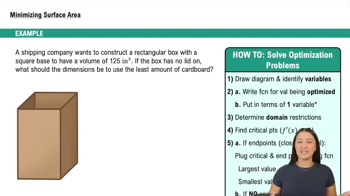
Example 1: Minimizing Surface Area

Derivative

A derivative represents the rate of change of a function with respect to a variable. In this context, it helps determine how the lateral surface area A changes as the radius r varies, while keeping the height h constant. The derivative is calculated using differentiation rules, which provide insights into the behavior of the function at specific points.
Recommended video:
05:44
Derivatives

Evaluation of Derivatives

Evaluating a derivative involves substituting specific values into the derivative function to find the instantaneous rate of change at those points. In this case, after finding the derivative of the lateral surface area with respect to r, we will substitute r = 30 and h = 40 to compute the exact rate of change of the surface area at that radius.
Recommended video:
5:14
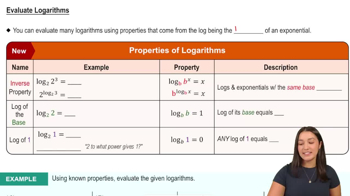
Evaluate Logarithms
Related Practice
Textbook Question

62–65. {Use of Tech} Graphing f and f'

b. Compute and graph f'.

f(x) = (x−1) sin^−1 x on [−1,1]

175
views
Textbook Question

79–82. {Use of Tech} Visualizing tangent and normal lines

b. Graph the tangent and normal lines on the given graph.

x⁴ = 2x²+2y²; (x0, y0)=(2, 2) (kampyle of Eudoxus)

264
views
Textbook Question

{Use of Tech} Hours of daylight The number of hours of daylight at any point on Earth fluctuates throughout the year. In the Northern Hemisphere, the shortest day is on the winter solstice and the longest day is on the summer solstice. At 40° north latitude, the length of a day is approximated by D(t) = 12−3 cos (2π(t+10) / 365), where D is measured in hours and 0≤t≤365 is measured in days, with t=0 corresponding to January 1.

b. Find the rate at which the daylight function changes.

389
views
Textbook Question

Use a graphing utility to plot the curve and the tangent line.

y = cos x / 1−cos x; x = π/3

278
views
Textbook Question

62–65. {Use of Tech} Graphing f and f'

c. Verify that the zeros of f' correspond to points at which f has a horizontal tangent line.

f(x)=e^−x tan^−1 x on [0,∞)

145
views
Textbook Question

City urbanization City planners model the size of their city using the function A(t) = - 1/50t² + 2t +20, for 0 ≤ t ≤ 50, where A is measured in square miles and t is the number of years after 2010.

c. Suppose the population density of the city remains constant from year to year at 1000 people mi². Determine the growth rate of the population in 2030.

297
views