Ch. 1 - Functions
Hass - Thomas' Calculus 15th Edition
Hass15th EditionThomas' CalculusISBN: 9780137616077Not the one you use?Change textbook
Chapter 1, Problem 1.2.79d

Combining Functions


Assume that f is an even function, g is an odd function, and both f and g are defined on the entire real line (−∞,∞). Which of the following (where defined) are even? odd?


d. f² = ff

Verified step by step guidance
1
First, recall the definitions of even and odd functions. An even function satisfies f(x) = f(-x) for all x in its domain, while an odd function satisfies g(x) = -g(-x).
Consider the function f² = ff. This means we are looking at the function h(x) = f(x) * f(x).
Since f is an even function, we have f(x) = f(-x). Therefore, f²(x) = f(x) * f(x) = f(-x) * f(-x) = f²(-x).
This shows that f²(x) = f²(-x), which is the definition of an even function. Therefore, f² is an even function.
To summarize, when you square an even function, the result is still an even function. This is because the property f(x) = f(-x) is preserved when multiplying the function by itself.

Verified video answer for a similar problem:

This video solution was recommended by our tutors as helpful for the problem above.
Video duration:
2m
Was this helpful?

Key Concepts

Here are the essential concepts you must grasp in order to answer the question correctly.

Even and Odd Functions

An even function satisfies the condition f(-x) = f(x) for all x in its domain, meaning its graph is symmetric about the y-axis. An odd function meets the condition g(-x) = -g(x), indicating that its graph is symmetric about the origin. Understanding these definitions is crucial for determining the nature of combined functions.
Recommended video:
06:21
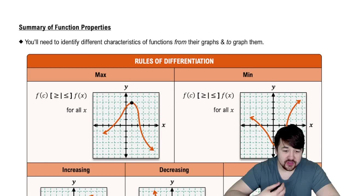
Properties of Functions

Function Composition and Products

When combining functions, such as through addition, multiplication, or composition, the resulting function's parity (even or odd) can often be determined by the properties of the original functions. For instance, the product of two even functions is even, while the product of an even and an odd function is odd. This concept is essential for analyzing the function f² = ff.
Recommended video:
05:18
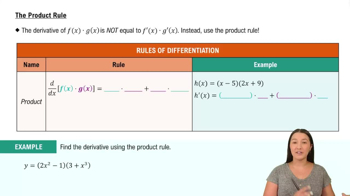
The Product Rule

Properties of Function Powers

When raising a function to a power, the parity of the function influences the result. Specifically, if f is even, then f² is also even, as squaring preserves symmetry about the y-axis. This property is vital for evaluating whether f² retains the evenness of f, which is central to answering the question posed.
Recommended video:
06:21
Properties of Functions