Ch. 6 - Applications of Integration
Briggs - Calculus: Early Transcendentals 3rd Edition
Briggs3rd EditionCalculus: Early TranscendentalsISBN: 9780136847243Not the one you use?Change textbook
Chapter 6, Problem 6.RE.68f

Variable gravity At Earth’s surface, the acceleration due to gravity is approximately g=9.8 m/s² (with local variations). However, the acceleration decreases with distance from the surface according to Newton’s law of gravitation. At a distance of y meters from Earth’s surface, the acceleration is given by a(y) = - g / (1+y/R)², where R=6.4×10⁶ m is the radius of Earth.


f. Graph ymax as a function of v0. What is the maximum height when v0=500 m/s,1500 m/s, and 5 km/s?

Verified step by step guidance
1
Understand the problem context: The acceleration due to gravity varies with height y above Earth's surface according to the formula \(a(y) = - \frac{g}{(1 + \frac{y}{R})^2}\), where \(g = 9.8 \ \text{m/s}^2\) and \(R = 6.4 \times 10^6 \ \text{m}\). We want to find the maximum height \(y_{max}\) reached by an object launched upward with initial velocity \(v_0\).
Set up the equation of motion using energy conservation or kinematics with variable acceleration. Since acceleration depends on height, use the work-energy principle: the initial kinetic energy converts into gravitational potential energy. The velocity at height \(y\) satisfies \(v \frac{dv}{dy} = a(y)\).
Rewrite the differential equation: \(v \frac{dv}{dy} = - \frac{g}{(1 + \frac{y}{R})^2}\). Separate variables to integrate: \(v dv = - \frac{g}{(1 + \frac{y}{R})^2} dy\).
Integrate both sides from initial conditions: when \(y=0\), \(v = v_0\); at maximum height \(y = y_{max}\), \(v=0\). So, integrate \(\int_{v_0}^0 v dv = -g \int_0^{y_{max}} \frac{dy}{(1 + \frac{y}{R})^2}\).
Solve the integrals: The left side is \(\frac{1}{2}(0^2 - v_0^2) = -\frac{v_0^2}{2}\). The right side integral can be computed by substitution \(u = 1 + \frac{y}{R}\), leading to an expression for \(y_{max}\) in terms of \(v_0\), \(g\), and \(R\). Use this formula to find \(y_{max}\) for \(v_0 = 500 \ \text{m/s}\), \(1500 \ \text{m/s}\), and \(5000 \ \text{m/s}\) (5 km/s).

Verified video answer for a similar problem:

This video solution was recommended by our tutors as helpful for the problem above.
Video duration:
7m
Was this helpful?

Key Concepts

Here are the essential concepts you must grasp in order to answer the question correctly.

Variable Acceleration Due to Gravity

Unlike constant gravity near Earth's surface, acceleration due to gravity decreases with height according to Newton's law of gravitation. The formula a(y) = -g / (1 + y/R)² shows how gravity weakens as distance y from the surface increases, where R is Earth's radius. This variation affects the motion of objects moving vertically.
Recommended video:
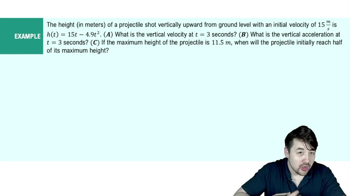
06:51
Derivatives Applied To Acceleration Example 2

Kinematic Equations with Variable Acceleration

Standard kinematic equations assume constant acceleration, but here acceleration depends on height. To find maximum height ymax for a given initial velocity v0, one must use calculus, integrating acceleration or velocity as functions of position or time, rather than simple formulas.
Recommended video:
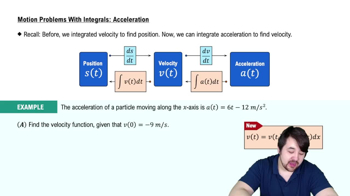
08:14
Using The Acceleration Function

Graphing ymax as a Function of Initial Velocity v0

Plotting ymax versus v0 involves calculating maximum heights for various initial speeds and visualizing their relationship. This helps understand how increasing initial velocity affects maximum height under variable gravity, highlighting nonlinear behavior especially at high speeds.
Recommended video:
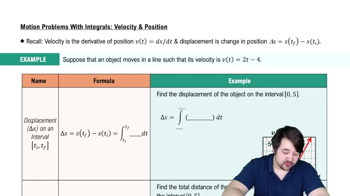
10:17
Using The Velocity Function