Ch. 2 - Limits
Briggs - Calculus: Early Transcendentals 3rd Edition
Briggs3rd EditionCalculus: Early TranscendentalsISBN: 9780136847243Not the one you use?Change textbook
Chapter 2, Problem 58

Evaluate each limit. 


lim x→0+ 1−cos^2x / sin x

Verified step by step guidance
1
Step 1: Recognize that the expression \(1 - \cos^2 x\) can be rewritten using the Pythagorean identity \(\sin^2 x + \cos^2 x = 1\). Therefore, \(1 - \cos^2 x = \sin^2 x\).
Step 2: Substitute \(\sin^2 x\) for \(1 - \cos^2 x\) in the limit expression. The limit now becomes \(\lim_{{x \to 0^+}} \frac{\sin^2 x}{\sin x}\).
Step 3: Simplify the expression \(\frac{\sin^2 x}{\sin x}\) by canceling one \(\sin x\) from the numerator and the denominator. This simplifies to \(\sin x\).
Step 4: Evaluate the limit \(\lim_{{x \to 0^+}} \sin x\). Since \(\sin x\) is continuous at \(x = 0\), you can directly substitute \(x = 0\) into \(\sin x\).
Step 5: Conclude the evaluation by noting that the limit of \(\sin x\) as \(x\) approaches 0 from the positive side is simply \(\sin(0)\).

Verified video answer for a similar problem:

This video solution was recommended by our tutors as helpful for the problem above.
Video duration:
3m
Was this helpful?

Key Concepts

Here are the essential concepts you must grasp in order to answer the question correctly.

Limits

A limit is a fundamental concept in calculus that describes the behavior of a function as its input approaches a certain value. In this case, we are interested in the limit of the expression as x approaches 0 from the positive side (0+). Understanding limits is crucial for evaluating functions that may not be directly computable at specific points.
Recommended video:
05:50
One-Sided Limits

Trigonometric Functions

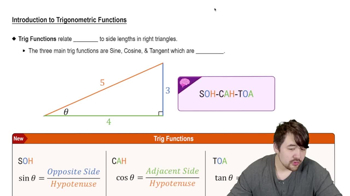
Trigonometric functions, such as sine and cosine, are periodic functions that relate angles to ratios of sides in right triangles. In the given limit, we encounter cos^2(x) and sin(x), which require knowledge of their properties and behaviors, especially near critical points like x = 0, where they can exhibit specific limits and values.
Recommended video:
6:04
Introduction to Trigonometric Functions

L'Hôpital's Rule

L'Hôpital's Rule is a method used to evaluate limits that result in indeterminate forms, such as 0/0 or ∞/∞. It states that if the limit of f(x)/g(x) leads to an indeterminate form, the limit can be found by taking the derivative of the numerator and the derivative of the denominator. This rule is particularly useful in simplifying complex limit problems involving trigonometric functions.
Recommended video: