Ch. 8 - Integration Techniques
Briggs - Calculus: Early Transcendentals 3rd Edition
Briggs3rd EditionCalculus: Early TranscendentalsISBN: 9780136847243Not the one you use?Change textbook
Chapter 8, Problem 8.7.21

7–40. Table look-up integrals Use a table of integrals to evaluate the following indefinite integrals. Some of the integrals require preliminary work, such as completing the square or changing variables, before they can be found in a table.
21. ∫ cos x / (sin² x + 2 sin x) dx

Verified step by step guidance
1
Step 1: Begin by analyzing the denominator of the integrand, sin²(x) + 2sin(x). Notice that this expression can be rewritten by completing the square. Rewrite it as (sin(x) + 1)² - 1.
Step 2: Perform a substitution to simplify the integral. Let u = sin(x) + 1, which implies that du = cos(x) dx. This substitution transforms the integral into ∫ du / (u² - 1).
Step 3: Recognize that the new integral ∫ du / (u² - 1) matches a standard form found in a table of integrals. Specifically, it resembles the integral of 1 / (x² - a²), which has a known solution.
Step 4: Use the table of integrals to find the solution for ∫ du / (u² - 1). The result will involve logarithmic functions, specifically ln|u - 1| and ln|u + 1|.
Step 5: Substitute back u = sin(x) + 1 into the solution obtained from the table to express the final answer in terms of x. Simplify the expression if necessary.

Verified video answer for a similar problem:

This video solution was recommended by our tutors as helpful for the problem above.
Video duration:
8m
Was this helpful?

Key Concepts

Here are the essential concepts you must grasp in order to answer the question correctly.

Indefinite Integrals

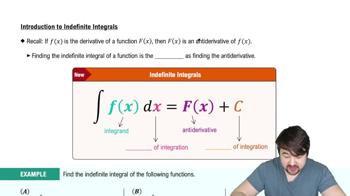
Indefinite integrals represent a family of functions whose derivative is the integrand. They are expressed without limits and include a constant of integration, typically denoted as 'C'. Understanding how to evaluate indefinite integrals is crucial for solving problems in calculus, as they provide the antiderivative of a function.
Recommended video:
05:04
Introduction to Indefinite Integrals

Integration Techniques

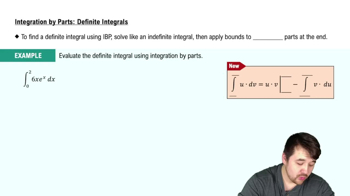
Various techniques are employed to evaluate integrals, including substitution, integration by parts, and using tables of integrals. In this case, recognizing the need for preliminary work, such as completing the square or changing variables, is essential to transform the integrand into a form that can be easily matched with entries in an integral table.
Recommended video:
06:18
Integration by Parts for Definite Integrals

Completing the Square

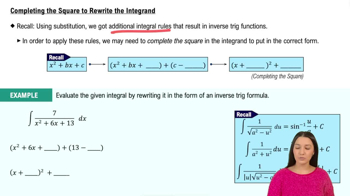
Completing the square is a method used to rewrite quadratic expressions in a specific form, which can simplify integration. This technique involves rearranging a quadratic expression into a perfect square trinomial plus a constant. It is particularly useful when dealing with integrals that contain quadratic terms in the denominator, as it can facilitate easier integration.
Recommended video:
05:22
Completing the Square to Rewrite the Integrand