Population growth Consider the following population functions. c. Estimate the time when the instantaneous growth rate is greatest. p(t) = 600 (t²+3/t²+9)
Verified step by step guidance
1
Step 1: Understand that the instantaneous growth rate of a population function p(t) is given by its derivative, p'(t). Therefore, we need to find the derivative of the given function p(t) = 600 \left(\frac{t^2 + 3}{t^2 + 9}\right).
Step 2: Use the quotient rule to differentiate p(t). The quotient rule states that if you have a function in the form of \(\frac{u(t)}{v(t)}\), its derivative is \(\frac{u'(t)v(t) - u(t)v'(t)}{(v(t))^2}\). Here, let u(t) = t^2 + 3 and v(t) = t^2 + 9.
Step 3: Calculate the derivatives u'(t) and v'(t). For u(t) = t^2 + 3, the derivative u'(t) = 2t. For v(t) = t^2 + 9, the derivative v'(t) = 2t.
Step 4: Substitute u(t), v(t), u'(t), and v'(t) into the quotient rule formula to find p'(t). This will give you the expression for the instantaneous growth rate of the population function.
Step 5: Analyze the expression for p'(t) to determine when it is greatest. This involves finding the critical points by setting p'(t) = 0 and solving for t, and then using the second derivative test or analyzing the sign changes of p'(t) to identify the maximum growth rate.
Verified video answer for a similar problem:
This video solution was recommended by our tutors as helpful for the problem above
Video duration:
7m
Play a video:
Was this helpful?
Key Concepts
Here are the essential concepts you must grasp in order to answer the question correctly.
Instantaneous Growth Rate
The instantaneous growth rate of a function describes how fast the function is changing at a specific point in time. In calculus, this is determined by finding the derivative of the function, which gives the slope of the tangent line at any point. For population functions, this rate can indicate how quickly the population is increasing at a given moment.
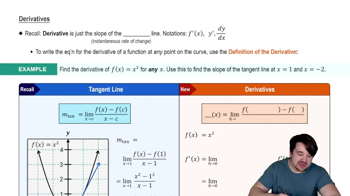
Derivatives are fundamental tools in calculus that measure how a function changes as its input changes. The derivative of a function p(t) with respect to time t, denoted as p'(t), provides the instantaneous rate of change of the population at time t. To find the maximum growth rate, one must analyze the derivative to locate critical points where the growth rate is at its peak.
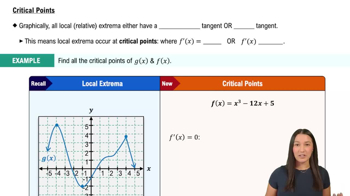
Critical points occur where the derivative of a function is either zero or undefined. These points are essential for determining local maxima and minima of the function. In the context of population growth, identifying critical points in the derivative of p(t) allows us to estimate when the population's instantaneous growth rate reaches its maximum, which is crucial for understanding population dynamics.