Ch. 2 - Limits
Briggs - Calculus: Early Transcendentals 3rd Edition
Briggs3rd EditionCalculus: Early TranscendentalsISBN: 9780136847243Not the one you use?Change textbook
Chapter 2, Problem 2.48

Determine the interval(s) on which the following functions are continuous. At which finite endpoints of the intervals of continuity is f continuous from the left or continuous from the right? 


f(z)=(z−1)^3/4

Verified step by step guidance
1
The function \( f(z) = (z-1)^{3/4} \) is a power function with a fractional exponent. Fractional exponents can introduce discontinuities, especially when the base is negative.
The base of the power function is \( z-1 \). For the expression \( (z-1)^{3/4} \) to be real-valued, \( z-1 \) must be non-negative because the fourth root of a negative number is not real. Therefore, \( z-1 \geq 0 \), which implies \( z \geq 1 \).
Based on the domain restriction, the function is defined and continuous for \( z \geq 1 \). Thus, the interval of continuity is \([1, \infty)\).
At \( z = 1 \), the function \( f(z) = (z-1)^{3/4} \) evaluates to zero, which is defined. Since the function is defined and continuous for all \( z \geq 1 \), it is continuous from the right at \( z = 1 \).
The function is continuous on the interval \([1, \infty)\) and continuous from the right at the endpoint \( z = 1 \).

Verified video answer for a similar problem:

This video solution was recommended by our tutors as helpful for the problem above.
Video duration:
3m
Was this helpful?

Key Concepts

Here are the essential concepts you must grasp in order to answer the question correctly.

Continuity of Functions

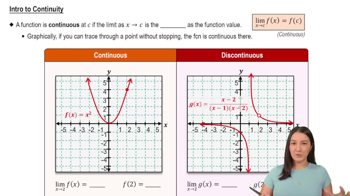
A function is continuous at a point if the limit of the function as it approaches that point equals the function's value at that point. For a function to be continuous over an interval, it must be continuous at every point within that interval. This concept is crucial for determining where the function does not have breaks, jumps, or asymptotes.
Recommended video:
05:34
Intro to Continuity

Endpoints of Intervals

Endpoints of intervals are the boundary points that define the start and end of an interval. When analyzing continuity, it is important to check the behavior of the function at these endpoints, particularly whether the function approaches a finite limit from the left or right. This helps in identifying if the function is continuous from one side at these points.
Recommended video:
03:34
Finding Global Extrema (Extreme Value Theorem) Example 4

Piecewise Functions and Roots

The function given, f(z) = (z - 1)^(3/4), involves a root which can affect continuity. Specifically, roots can introduce points where the function is not defined or is discontinuous. Understanding how to handle roots, especially when they are raised to fractional powers, is essential for determining the intervals of continuity and the nature of the function at those points.
Recommended video:
05:36
Piecewise Functions