
Ch. 10 - Sequences and Infinite Series
Briggs - Calculus: Early Transcendentals 3rd Edition
Briggs3rd EditionCalculus: Early TranscendentalsISBN: 9780136847243Not the one you use?Change textbook
Chapter 10, Problem 10.7.31d

Explain why or why not Determine whether the following statements are true and give an explanation or counterexample.


d. The Ratio Test is always inconclusive when applied to ∑ aₖ, where aₖ is a nonzero rational function of k.

Verified step by step guidance
1
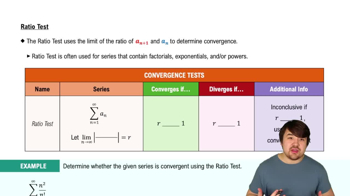
Recall the Ratio Test: For a series \( \sum a_k \), the Ratio Test considers the limit \( L = \lim_{k \to \infty} \left| \frac{a_{k+1}}{a_k} \right| \). If \( L < 1 \), the series converges absolutely; if \( L > 1 \), the series diverges; if \( L = 1 \), the test is inconclusive.
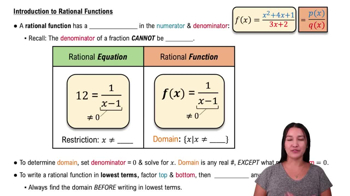
Understand what it means for \( a_k \) to be a nonzero rational function of \( k \): \( a_k = \frac{p(k)}{q(k)} \), where \( p(k) \) and \( q(k) \) are polynomials and \( a_k \neq 0 \) for all \( k \).
Analyze the behavior of the ratio \( \left| \frac{a_{k+1}}{a_k} \right| = \left| \frac{p(k+1)}{q(k+1)} \cdot \frac{q(k)}{p(k)} \right| \). Since \( p(k) \) and \( q(k) \) are polynomials, the ratio of consecutive terms tends to 1 as \( k \to \infty \) because the highest degree terms dominate and their ratio approaches 1.
Since the limit \( L \) of the ratio is 1, the Ratio Test is inconclusive for series where \( a_k \) is a nonzero rational function of \( k \).
Therefore, the statement is true: the Ratio Test is always inconclusive when applied to \( \sum a_k \) with \( a_k \) a nonzero rational function of \( k \).

Verified video answer for a similar problem:

This video solution was recommended by our tutors as helpful for the problem above.
Video duration:
3m
Was this helpful?

Key Concepts

Here are the essential concepts you must grasp in order to answer the question correctly.

Ratio Test

The Ratio Test is a method to determine the convergence or divergence of an infinite series by examining the limit of the absolute value of the ratio of consecutive terms. If this limit is less than 1, the series converges absolutely; if greater than 1, it diverges; if equal to 1, the test is inconclusive.
Recommended video:
05:35
Ratio Test

Rational Functions of k

A rational function of k is a ratio of two polynomials in the variable k. Such functions often appear in series terms, and their growth rates influence the behavior of the series, especially when applying convergence tests like the Ratio Test.
Recommended video:
6:04
Intro to Rational Functions

Limit Behavior of Rational Functions in Series

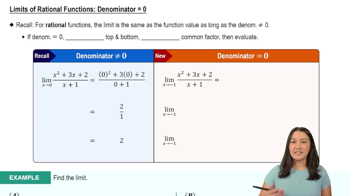
When applying the Ratio Test to series with terms as rational functions, the limit of the ratio of consecutive terms often approaches 1, making the test inconclusive. Understanding how polynomial degrees in numerator and denominator affect this limit is key to analyzing convergence.
Recommended video:
06:11
Limits of Rational Functions: Denominator = 0
Related Practice
Textbook Question

72–75. {Use of Tech} Practical sequences

Consider the following situations that generate a sequence


d.Using a calculator or a graphing utility, estimate the limit of the sequence or state that it does not exist.


Drug elimination

Jack took a 200-mg dose of a pain killer at midnight. Every hour, 5% of the drug is washed out of his bloodstream. Let dₙ be the amount of drug in Jack’s blood n hours after the drug was taken, where d₀ = 200mg.

35
views
Textbook Question

87. Explain why or why not

Determine whether the following statements are true and give an explanation or counterexample.


e. ∑ (k = 1 to ∞) (π / e)⁻ᵏ is a convergent geometric series.

45
views
Textbook Question

41–44. {Use of Tech} Remainders and estimates Consider the following convergent series.


d. Find an interval in which the value of the series must lie if you approximate it using ten terms of the series.


41. ∑ (k = 1 to ∞) 1 / k⁶

60
views
Textbook Question

Explain why or why not Determine whether the following statements are true and give an explanation or counterexample.

e. If ∑ k⁻ᵖ converges, then ∑ k⁻ᵖ⁺⁰.⁰⁰¹ converges.

38
views
Textbook Question

87. Explain why or why not

Determine whether the following statements are true and give an explanation or counterexample.


d. If ∑ pᵏ diverges, then ∑ (p + 0.001)ᵏ diverges, for a fixed real number p.

44
views
Textbook Question

Explain why or why not Determine whether the following statements are true and give an explanation or counterexample.


d. Every partial sum Sₙ of the series ∑ (k = 1 to ∞) 1 / k² underestimates the exact value of ∑ (k = 1 to ∞) 1 / k².

39
views