90–103. Indefinite integrals Determine the following indefinite integrals.
∫ dx / (1 - sin² x)
Verified step by step guidance
1
Recognize that the denominator, \(1 - \sin^2 x\), can be simplified using the Pythagorean identity \(\sin^2 x + \cos^2 x = 1\). This simplifies \(1 - \sin^2 x\) to \(\cos^2 x\).
Rewrite the integral as \(\int \frac{dx}{\cos^2 x}\).
Recall that \(\frac{1}{\cos^2 x}\) is equivalent to \(\sec^2 x\). Substitute this into the integral to get \(\int \sec^2 x \, dx\).
Use the standard integral formula \(\int \sec^2 x \, dx = \tan x + C\), where \(C\) is the constant of integration.
Conclude that the solution to the integral is \(\tan x + C\).
Verified video answer for a similar problem:
This video solution was recommended by our tutors as helpful for the problem above
Video duration:
1m
Play a video:
0 Comments
Key Concepts
Here are the essential concepts you must grasp in order to answer the question correctly.
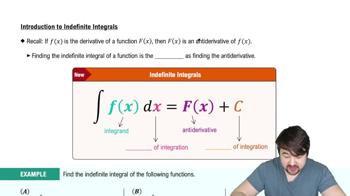
Indefinite Integrals
Indefinite integrals represent a family of functions whose derivative is the integrand. They are expressed without limits and include a constant of integration, typically denoted as 'C'. The process of finding an indefinite integral is often referred to as antidifferentiation, and it is fundamental in calculus for solving problems related to area under curves and accumulation functions.
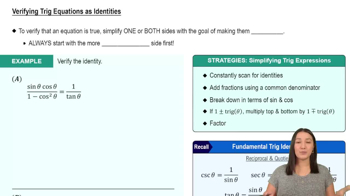
Trigonometric identities are equations involving trigonometric functions that are true for all values of the variables involved. A key identity relevant to the given integral is the Pythagorean identity, which states that sin²(x) + cos²(x) = 1. This identity can be used to simplify expressions involving sine and cosine, making it easier to evaluate integrals that include these functions.
The substitution method is a technique used in integration to simplify the integrand by changing variables. This method involves substituting a part of the integrand with a new variable, which can make the integral easier to solve. In the context of the given integral, recognizing that 1 - sin²(x) can be rewritten as cos²(x) allows for a straightforward integration process.