Ch. 9 - Differential Equations
Briggs - Calculus: Early Transcendentals 3rd Edition
Briggs3rd EditionCalculus: Early TranscendentalsISBN: 9780136847243Not the one you use?Change textbook
Chapter 9, Problem 9.2.13

12–16. Sketching direction fields Use the window [-2, 2] x [-2, 2] to sketch a direction field for the following equations. Then sketch the solution curve that corresponds to the given initial condition. A detailed direction field is not needed.
y'(t) = 4−y, y(0) = −1

Verified step by step guidance
1
Identify the differential equation given: \(y'(t) = 4 - y\). This means the slope of the solution curve at any point \((t, y)\) depends on the value of \(y\) at that point.
Set up a grid of points in the window \([-2, 2] \times [-2, 2]\) for \(t\) and \(y\). At each point \((t, y)\), calculate the slope \(y' = 4 - y\) to determine the direction of the solution curve.
At each grid point, draw a small line segment with slope equal to \(4 - y\). This collection of line segments forms the direction field, visually representing the behavior of solutions to the differential equation.
Use the initial condition \(y(0) = -1\) to locate the starting point on the \(t\)-\(y\) plane at \((0, -1)\). From this point, sketch a curve that follows the direction field, moving in the direction indicated by the slope segments.
Observe the general behavior of the solution curve: since \(y' = 4 - y\), when \(y\) is less than 4, the slope is positive, and when \(y\) is greater than 4, the slope is negative. This suggests the solution will approach the horizontal line \(y = 4\) as \(t\) increases.

Verified video answer for a similar problem:

This video solution was recommended by our tutors as helpful for the problem above.
Video duration:
5m
Was this helpful?

Key Concepts

Here are the essential concepts you must grasp in order to answer the question correctly.

Direction Fields

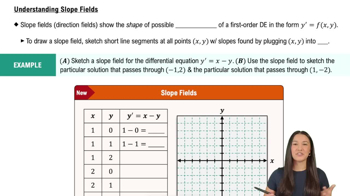
A direction field is a graphical representation of a first-order differential equation showing the slope of the solution curve at various points. Each small line segment indicates the slope y' at that point (t, y), helping visualize the behavior of solutions without solving the equation explicitly.
Recommended video:
05:45
Understanding Slope Fields

Initial Value Problems

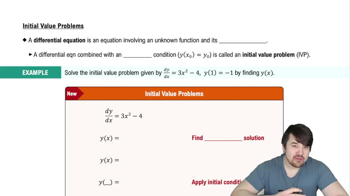
An initial value problem specifies a differential equation along with a starting point, such as y(0) = -1. This condition determines a unique solution curve passing through the given point, allowing us to sketch or find the particular solution that fits the initial data.
Recommended video:
05:03
Initial Value Problems

Solving First-Order Differential Equations

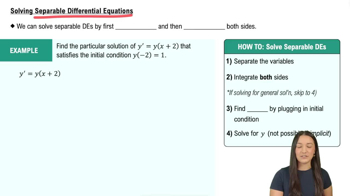
Understanding how to solve or analyze first-order differential equations like y' = 4 - y is essential. This often involves recognizing the equation type (e.g., separable or linear), which helps predict solution behavior and sketch solution curves consistent with the direction field.
Recommended video:
06:06
Solving Separable Differential Equations