
Textbook Question
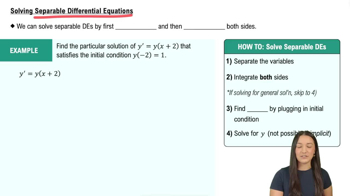
5–16. Solving separable equations Find the general solution of the following equations. Express the solution explicitly as a function of the independent variable.
y'(t) = eʸᐟ²sin t
57
views

 Verified step by step guidance
 06:06
06:06
 05:03
05:03 6:04
6:045–16. Solving separable equations Find the general solution of the following equations. Express the solution explicitly as a function of the independent variable.
y'(t) = eʸᐟ²sin t
33–38. {Use of Tech} Solutions in implicit form Solve the following initial value problems and leave the solution in implicit form. Use graphing software to plot the solution. If the implicit solution describes more than one function, be sure to indicate which function corresponds to the solution of the initial value problem.
yy'(x) = 2x/(2 + y)², y(1) = −1
What is a separable first-order differential equation?
33–42. Solving initial value problems Solve the following initial value problems.
y'(t) = 1 + eᵗ, y(0) = 4
9–14. Growth rate functions Make a sketch of the population function P (as a function of time) that results from the following growth rate functions. Assume the population at time t = 0 begins at some positive value.
12–16. Sketching direction fields Use the window [-2, 2] x [-2, 2] to sketch a direction field for the following equations. Then sketch the solution curve that corresponds to the given initial condition. A detailed direction field is not needed.
y'(t) = 4−y, y(0) = −1