Ch. 3 - Derivatives
Briggs - Calculus: Early Transcendentals 3rd Edition
Briggs3rd EditionCalculus: Early TranscendentalsISBN: 9780136847243Not the one you use?Change textbook
Chapter 3, Problem 87d

Determine whether the following statements are true and give an explanation or counterexample.
d/dx((√2)x) = x(√2)x - 1

Verified step by step guidance
1
Step 1: Recognize the function given is \( f(x) = (\sqrt{2})^x \). This is an exponential function where the base is \( \sqrt{2} \).
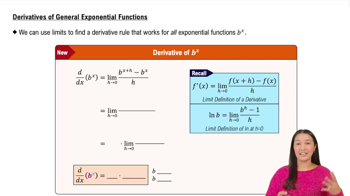
Step 2: Recall the derivative rule for exponential functions of the form \( a^x \), which is \( \frac{d}{dx}(a^x) = a^x \ln(a) \).
Step 3: Apply the derivative rule to \( f(x) = (\sqrt{2})^x \). The derivative is \( (\sqrt{2})^x \ln(\sqrt{2}) \).
Step 4: Compare the derived expression \( (\sqrt{2})^x \ln(\sqrt{2}) \) with the given expression \( x(\sqrt{2})^{x-1} \).
Step 5: Conclude that the given statement is false because \( (\sqrt{2})^x \ln(\sqrt{2}) \neq x(\sqrt{2})^{x-1} \). The correct derivative involves the natural logarithm of the base, not a multiplication by \( x \).

Verified video answer for a similar problem:

This video solution was recommended by our tutors as helpful for the problem above.
Video duration:
2m

Key Concepts

Here are the essential concepts you must grasp in order to answer the question correctly.

Derivative of Exponential Functions

The derivative of an exponential function of the form a^x, where a is a constant, is given by d/dx(a^x) = a^x * ln(a). This rule is essential for differentiating functions where the base is a constant raised to a variable exponent, such as (√2)^x.
Recommended video:
04:50
Derivatives of General Exponential Functions

Power Rule

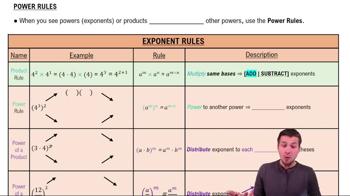
The power rule states that if f(x) = x^n, then f'(x) = n*x^(n-1). This rule is commonly used for differentiating polynomial functions and is not applicable to exponential functions where the base is a constant.
Recommended video:
5:50
Power Rules

Counterexamples in Mathematics

A counterexample is a specific case that disproves a general statement. In this context, providing a counterexample to the statement d/dx((√2)^x) = x(√2)^(x - 1) would involve showing that the left-hand side does not equal the right-hand side for any value of x, thus demonstrating the statement's falsehood.
Recommended video:
Guided course
05:13
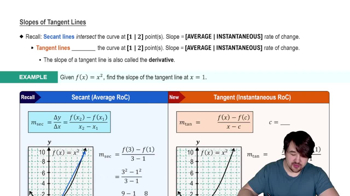
Slopes of Tangent Lines