Ch. 5 - Integration
Briggs - Calculus: Early Transcendentals 3rd Edition
Briggs3rd EditionCalculus: Early TranscendentalsISBN: 9780136847243Not the one you use?Change textbook
Chapter 5, Problem 5.3.27

Definite integrals Evaluate the following integrals using the Fundamental Theorem of Calculus. Sketch the graph of the integrand and shade the region whose net area you have found.                       
                                                                                                                                                                                       
 โˆซโ‚€โต (๐“ยฒโ€•9) d๐“ 

Verified step by step guidance
1
Step 1: Identify the integral to be evaluated. The problem asks us to compute the definite integral โˆซโ‚€โต (๐“ยฒ - 9) d๐“ using the Fundamental Theorem of Calculus.
Step 2: Find the antiderivative of the integrand (๐“ยฒ - 9). The antiderivative of ๐“ยฒ is (๐“ยณ)/3, and the antiderivative of -9 is -9๐“. Therefore, the antiderivative of (๐“ยฒ - 9) is F(๐“) = (๐“ยณ)/3 - 9๐“.
Step 3: Apply the Fundamental Theorem of Calculus. This theorem states that for a continuous function f(๐“) on [a, b], the definite integral โˆซโ‚แต‡ f(๐“) d๐“ is equal to F(b) - F(a), where F(๐“) is the antiderivative of f(๐“). Here, we evaluate F(5) - F(0).
Step 4: Substitute the limits of integration into the antiderivative. Compute F(5) = (5ยณ)/3 - 9(5) and F(0) = (0ยณ)/3 - 9(0). Then subtract F(0) from F(5).
Step 5: Sketch the graph of the integrand f(๐“) = ๐“ยฒ - 9. This is a parabola opening upwards with its vertex at (0, -9). Shade the region between the curve and the x-axis from x = 0 to x = 5. Note that the area below the x-axis contributes negatively to the net area.

Verified video answer for a similar problem:

This video solution was recommended by our tutors as helpful for the problem above.
Video duration:
3m
Was this helpful?

Key Concepts

Here are the essential concepts you must grasp in order to answer the question correctly.

Fundamental Theorem of Calculus

The Fundamental Theorem of Calculus connects differentiation and integration, stating that if a function is continuous on an interval [a, b], then the integral of its derivative over that interval equals the difference in the values of the original function at the endpoints. This theorem allows us to evaluate definite integrals by finding an antiderivative of the integrand and applying the limits of integration.
Recommended video:
06:11
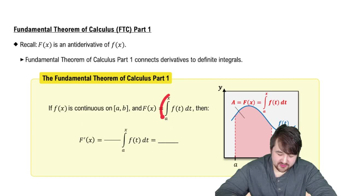
Fundamental Theorem of Calculus Part 1

Definite Integral

A definite integral represents the net area under a curve defined by a function over a specific interval [a, b]. It is calculated as the limit of Riemann sums and provides a numerical value that can be interpreted as the accumulation of quantities, such as area, over that interval. The definite integral is denoted as โˆซโ‚แต‡ f(x) dx, where f(x) is the integrand.
Recommended video:
05:43
Definition of the Definite Integral

Graphing the Integrand

Graphing the integrand involves plotting the function that is being integrated, which helps visualize the area under the curve. In the context of definite integrals, shading the region between the curve and the x-axis over the interval [a, b] illustrates the net area calculated by the integral. This visual representation aids in understanding the relationship between the function and its integral.
Recommended video:
06:15
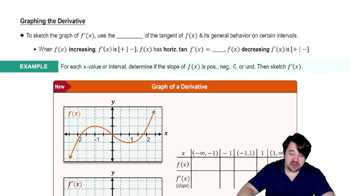
Graphing The Derivative
Related Practice
Textbook Question

Areas of regions Find the area of the following regions.                                                                                                                   

                                                                                                                                                                 The region bounded by the graph of ฦ’(๐“) = x /โˆš(๐“ยฒ โ€•9) and the ๐“-axis between and ๐“ = 4 and ๐“= 5

28
views
Textbook Question

Indefinite integrals Use a change of variables or Table 5.6 to evaluate the following indefinite integrals. Check your work by differentiating.                                                                                  


 โˆซ 2๐“(๐“ยฒ โ€• 1)โนโน d๐“

86
views
Textbook Question

Indefinite integrals Use a change of variables or Table 5.6 to evaluate the following indefinite integrals. Check your work by differentiating.                                                                                  


 โˆซ [ 1/(10๐“โ€•3) d๐“

57
views
Textbook Question

Definite integrals Use a change of variables or Table 5.6 to evaluate the following definite integrals.                                                                                                                         


 โˆซโ‚€แต‰ยฒ (ln p)/p dp

76
views