Textbook Question
29–62. Integrals Evaluate the following integrals. Include absolute values only when needed.
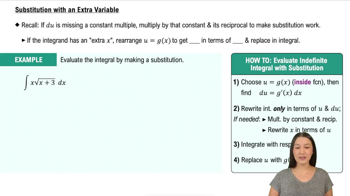
∫ e^{2x} / (4 + e^{2x}) dx
54
views

 Briggs 3rd EditionCh. 7 - Logarithmic, Exponential Functions, and Hyperbolic FunctionsProblem 7.1.54
 Verified step by step guidance

 05:43
05:43
 04:27
04:27 06:21
06:2129–62. Integrals Evaluate the following integrals. Include absolute values only when needed.
∫ e^{2x} / (4 + e^{2x}) dx
Catenary arch The portion of the curve y =17/15 - cosh x that lies above the x-axis forms a catenary arch. Find the average height of the arch above the x-axis.
15–20. Designing exponential growth functions Complete the following steps for the given situation.
a. Find the rate constant k and use it to devise an exponential growth function that fits the given data.
b. Answer the accompanying question.
Savings account An initial deposit of \$1500 is placed in a savings account with an APY of 3.1%. How long will it take until the balance of the account is \$2500? Assume the interest rate remains constant and no additional deposits or withdrawals are made.
29–62. Integrals Evaluate the following integrals. Include absolute values only when needed.
∫₁ᵉ^² (ln x)^5 / x dx
Derivative of ln|x| Differentiate ln x, for x > 0, and differentiate ln(−x), for x < 0, to conclude that d/dx (ln|x|) = 1/x
Logarithm properties Use the integral definition of the natural logarithm to prove that ln(x/y) = ln x - ln y.