
Ch. 8 - Integration Techniques
Briggs - Calculus: Early Transcendentals 3rd Edition
Briggs3rd EditionCalculus: Early TranscendentalsISBN: 9780136847243Not the one you use?Change textbook
Chapter 8, Problem 8.9.50

7–58. Improper integrals Evaluate the following integrals or state that they diverge.
50. ∫ (from 0 to 9) 1/(x - 1)¹ᐟ³ dx

Verified step by step guidance
1
Identify the type of integral and check for any points of discontinuity or singularities within the interval of integration. Here, the integrand is \(\frac{1}{(x - 1)^{1/3}}\), and the interval is from 0 to 9. Notice that the function is undefined at \(x = 1\) because the denominator becomes zero there.
Since \(x = 1\) lies within the interval of integration, split the integral at this point to handle the improper integral properly. Write the integral as the sum of two integrals: \(\int_0^1 \frac{1}{(x - 1)^{1/3}} \, dx + \int_1^9 \frac{1}{(x - 1)^{1/3}} \, dx\).
Rewrite each integral as a limit approaching the point of discontinuity. For the first integral, express it as \(\lim_{t \to 1^-} \int_0^t \frac{1}{(x - 1)^{1/3}} \, dx\). For the second integral, express it as \(\lim_{s \to 1^+} \int_s^9 \frac{1}{(x - 1)^{1/3}} \, dx\).
Find the antiderivative of the integrand \(\frac{1}{(x - 1)^{1/3}}\). Recall that \(\int (x - a)^n \, dx = \frac{(x - a)^{n+1}}{n+1} + C\) for \(n \neq -1\). Here, \(n = -\frac{1}{3}\), so the antiderivative is \(\frac{(x - 1)^{2/3}}{\frac{2}{3}} + C = \frac{3}{2} (x - 1)^{2/3} + C\).
Evaluate each limit by substituting the antiderivative back into the definite integrals and taking the limits as \(t \to 1^-\) and \(s \to 1^+\). Determine whether these limits converge to finite values or diverge to infinity to conclude if the original integral converges or diverges.

Verified video answer for a similar problem:

This video solution was recommended by our tutors as helpful for the problem above.
Video duration:
4m
Was this helpful?

Key Concepts

Here are the essential concepts you must grasp in order to answer the question correctly.

Improper Integrals

Improper integrals involve integrals with infinite limits or integrands with discontinuities within the interval. To evaluate them, one must consider limits approaching the problematic points to determine convergence or divergence.
Recommended video:
11:11
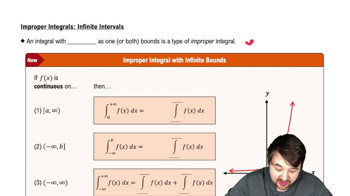
Improper Integrals: Infinite Intervals

Integrals with Discontinuous Integrands

When the integrand has a discontinuity inside the integration interval, the integral is split at the discontinuity point. Each part is evaluated as a limit approaching the discontinuity to check if the integral converges.
Recommended video:
05:22
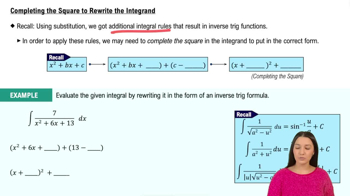
Completing the Square to Rewrite the Integrand

Behavior of Functions Near Singularities

Understanding how functions behave near points where they become unbounded or undefined is crucial. For example, functions like 1/(x - a)^p converge near x = a if p < 1, and diverge if p ≥ 1, guiding the evaluation of improper integrals.
Recommended video:
5:46
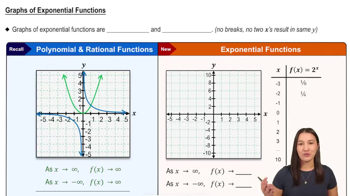
Graphs of Exponential Functions