Ch. 7 - Transcendental Functions
Hass - Thomas' Calculus 15th Edition
Hass15th EditionThomas' CalculusISBN: 9780137616077Not the one you use?Change textbook
Chapter 7, Problem 7.8.10.c

10. True, or false? As x→∞,
c. 1/x - 1/x² = o(1/x)

Verified step by step guidance
1
Recall the definition of the little-o notation: for functions f(x) and g(x), we say f(x) = o(g(x)) as x → ∞ if \( \lim_{x \to \infty} \frac{f(x)}{g(x)} = 0 \).
Identify the functions in the problem: \( f(x) = \frac{1}{x} - \frac{1}{x^2} \) and \( g(x) = \frac{1}{x} \).
Form the ratio \( \frac{f(x)}{g(x)} = \frac{\frac{1}{x} - \frac{1}{x^2}}{\frac{1}{x}} \).
Simplify the ratio: \( \frac{\frac{1}{x} - \frac{1}{x^2}}{\frac{1}{x}} = \frac{1}{x} \cdot \frac{x}{1} - \frac{1}{x^2} \cdot \frac{x}{1} = 1 - \frac{1}{x} \).
Evaluate the limit as \( x \to \infty \): \( \lim_{x \to \infty} \left(1 - \frac{1}{x}\right) = 1 \). Since this limit is not zero, conclude that \( \frac{1}{x} - \frac{1}{x^2} \neq o\left(\frac{1}{x}\right) \).

Verified video answer for a similar problem:

This video solution was recommended by our tutors as helpful for the problem above.
Video duration:
2m
Was this helpful?

Key Concepts

Here are the essential concepts you must grasp in order to answer the question correctly.

Little-o Notation

Little-o notation, written as f(x) = o(g(x)) as x→∞, means that f(x) becomes insignificant compared to g(x) in the limit. Formally, f(x)/g(x) → 0 as x→∞, indicating f(x) grows much slower than g(x). It is used to describe the relative growth rates of functions.
Recommended video:
04:22
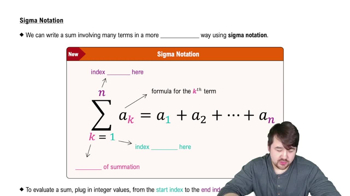
Sigma Notation

Asymptotic Behavior of Rational Functions

As x approaches infinity, terms like 1/x and 1/x² approach zero, but at different rates. Specifically, 1/x² tends to zero faster than 1/x, which affects how their differences behave asymptotically. Understanding these rates is key to comparing functions using little-o notation.
Recommended video:
5:50
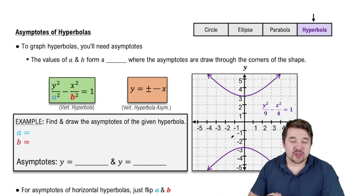
Asymptotes of Hyperbolas

Limit of a Quotient for Comparing Growth Rates

To determine if f(x) = o(g(x)), evaluate the limit of f(x)/g(x) as x→∞. If the limit is zero, f(x) is little-o of g(x). This method helps verify statements about asymptotic dominance, such as whether 1/x - 1/x² = o(1/x).
Recommended video:
03:55
The Quotient Rule Example 5
Related Practice
Textbook Question

1. Which of the following functions grow faster than e^x as x→∞? Which grow at the same rate as e^x? Which grow slower?

c. √x

25
views

Textbook Question

In Exercises 67–72, you will explore some functions and their inverses together with their derivatives and tangent line approximations at specified points. Perform the following steps using your CAS:

d. Find the equation for the tangent line to g at the point (f(x_0), x_0) located symmetrically across the 45° line y=x (which is the graph of the identity function). Use Theorem 1 to find the slope of this tangent line.

68. y= (3x+2)/(2x-11), -2 ≤ x ≤ 2, x_0=1/2

22
views
Textbook Question

In Exercises 67–72, you will explore some functions and their inverses together with their derivatives and tangent line approximations at specified points. Perform the following steps using your CAS:

c. Find the equation for the tangent line to f at the specified point (x_0, f(x_0)).

67. y= √(3x-2), 2/3 ≤ x ≤ 4, x_0=3

19
views
Textbook Question

In Exercises 67–72, you will explore some functions and their inverses together with their derivatives and tangent line approximations at specified points. Perform the following steps using your CAS:

c. Find the equation for the tangent line to f at the specified point (x_0, f(x_0)).

68. y= (3x+2)/(2x-11), -2 ≤ x ≤ 2, x_0=1/2

24
views
Textbook Question

In Exercises 1–4, show that each function y=f(x) is a solution of the accompanying differential equation.

1. 2y' + 3y = e^(-x)

c. y = e^(-x) + Ce^(-(3/2)x)

21
views
Textbook Question

5. Which of the following functions grow faster than ln(x) as x→∞? Which grow at the same rate as ln(x)? Which grow slower?

c. ln(√x)

27
views