Centroid: Find the centroid of the region bounded by the x-axis, the curve y = csc x, and the lines x = π/6, x = 5π/6.
Ch. 8 - Techniques of Integration
Chapter 8, Problem 8.3.68
Use any method to evaluate the integrals in Exercises 65–70.
∫ cot(x) / cos²(x) dx
Verified step by step guidance1
Rewrite the integrand to express it in terms of sine and cosine functions. Recall that \(\cot(x) = \frac{\cos(x)}{\sin(x)}\), so the integral becomes \(\int \frac{\cot(x)}{\cos^{2}(x)} \, dx = \int \frac{\cos(x)}{\sin(x) \cos^{2}(x)} \, dx\).
Simplify the integrand by canceling one \(\cos(x)\) term in the numerator and denominator, resulting in \(\int \frac{1}{\sin(x) \cos(x)} \, dx\).
Consider a substitution to simplify the integral. One useful substitution is to let \(u = \sin(x)\), which implies \(du = \cos(x) \, dx\). Rearranging, we get \(dx = \frac{du}{\cos(x)}\).
Substitute \(u\) and \(dx\) back into the integral. The integral becomes \(\int \frac{1}{u \cos(x)} \cdot \frac{du}{\cos(x)} = \int \frac{1}{u \cos^{2}(x)} \, du\). Since this still contains \(\cos(x)\), consider an alternative substitution or rewrite the integrand differently.
Alternatively, rewrite the original integrand as \(\cot(x) \sec^{2}(x)\) because \(\frac{1}{\cos^{2}(x)} = \sec^{2}(x)\). Then, use the substitution \(u = \sin(x)\), so \(du = \cos(x) \, dx\). Express \(\cot(x) \sec^{2}(x) \, dx\) in terms of \(u\) and \(du\) to evaluate the integral.

Verified video answer for a similar problem:
This video solution was recommended by our tutors as helpful for the problem above.
Video duration:
3mWas this helpful?
Key Concepts
Here are the essential concepts you must grasp in order to answer the question correctly.
Trigonometric Identities
Trigonometric identities are equations involving trigonometric functions that hold true for all values within their domains. They help simplify integrals by rewriting expressions in more manageable forms, such as expressing cotangent as cos(x)/sin(x) or using Pythagorean identities to transform powers of sine and cosine.
Recommended video:
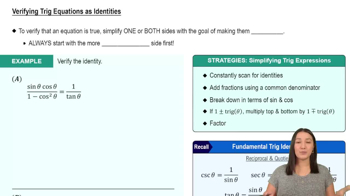
Verifying Trig Equations as Identities
Integration Techniques
Integration techniques include methods like substitution, integration by parts, and rewriting integrals to simpler forms. For integrals involving trigonometric functions, substitution is often used by identifying a function and its derivative within the integrand to simplify the integral into a basic form.
Recommended video:
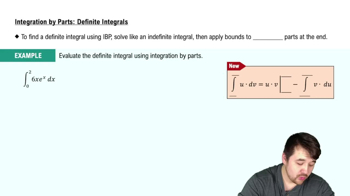
Integration by Parts for Definite Integrals
Handling Rational Trigonometric Functions
Rational trigonometric functions are ratios of trigonometric expressions, such as cot(x)/cos²(x). Understanding how to manipulate these ratios, often by expressing all terms in sine and cosine, is essential to simplify the integral and apply substitution or other integration methods effectively.
Recommended video:
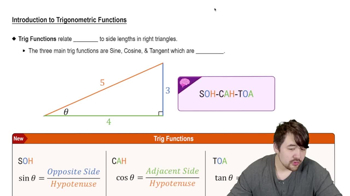
Introduction to Trigonometric Functions
Related Practice
Textbook Question
60
views
Textbook Question
Evaluate the integrals in Exercises 1–24 using integration by parts.
∫ θ cos(πθ) dθ
12
views
Textbook Question
In Exercises 39–48, use an appropriate substitution and then a trigonometric substitution to evaluate the integrals.
∫ √(1 - (ln x)²) / (x ln x) dx
32
views
Textbook Question
The integrals in Exercises 1–44 are in no particular order. Evaluate each integral using any algebraic method, trigonometric identity, or substitution you think is appropriate.
∫ (2^(√y) dy) / 2√y
30
views
Textbook Question
Expand the quotients in Exercises 1–8 by partial fractions.
z / (z³ - z² - 6z)
21
views
Textbook Question
Exercises 83–86 are about the infinite region in the first quadrant between the curve y = e^(-x) and the x-axis.
83. Find the area of the region.
21
views