Ch. 4 - Exponential and Logarithmic Functions
Blitzer - College Algebra 8th Edition
Blitzer8th EditionCollege AlgebraISBN: 9780136970514Not the one you use?Change textbook
Chapter 5, Problem 21

The graph of an exponential function is given. Select the function for each graph from the following options:
f(x)=3x,g(x)=3x1,h(x)=3x1,f(x)=3x,G(x)=3x,H(x)=3x.f(x) = 3^x, \(\quad\) g(x) = 3^{x-1}, \(\quad\) h(x) = 3^x - 1, \(\f\)(x) = -3^x, \(\quad\) G(x) = 3^{-x}, \(\quad\) H(x) = -3^{-x}.

Verified step by step guidance
1
Step 1: Identify the horizontal asymptote of the graph. The graph shows a horizontal asymptote at \(y = -1\), which means the function approaches \(-1\) as \(x\) goes to negative infinity.
Step 2: Recall that the basic exponential function \$3^x\( has a horizontal asymptote at \)y = 0\(. To shift this asymptote to \)y = -1\(, the function must be vertically shifted down by 1 unit. This suggests the function has the form \)3^x - 1$.
Step 3: Check the point given on the graph, which is \((1, 5)\). Substitute \(x = 1\) into the candidate function \$3^x - 1\( to verify: \)3^1 - 1 = 3 - 1 = 2\(, which does not match the point \)(1, 5)$.
Step 4: Consider the function \$3^{x-1}\(, which shifts the graph horizontally to the right by 1 unit. The asymptote remains at \)y = 0\(, so this does not match the asymptote at \)y = -1$.
Step 5: Since the asymptote is at \(y = -1\) and the graph passes through \((1, 5)\), the function must be \(f(x) = 3^x - 1\). The discrepancy in step 3 suggests rechecking the point or considering the vertical shift as the key feature to identify the function.

Verified video answer for a similar problem:

This video solution was recommended by our tutors as helpful for the problem above.
Video duration:
2m
Was this helpful?

Key Concepts

Here are the essential concepts you must grasp in order to answer the question correctly.

Exponential Functions and Their Graphs

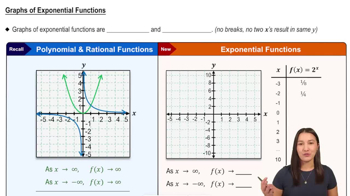
Exponential functions have the form f(x) = a^x, where the base a is positive and not equal to 1. Their graphs show rapid growth or decay, depending on the base and the exponent's sign. Key features include a horizontal asymptote and passing through specific points like (0,1) for f(x) = a^x.
Recommended video:
5:46
Graphs of Exponential Functions

Transformations of Exponential Functions

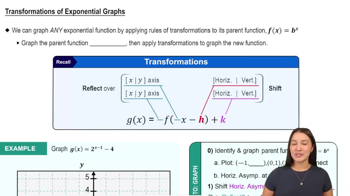
Transformations such as shifts and reflections modify the graph of an exponential function. Horizontal shifts change the input (e.g., f(x) = 3^(x-1) shifts right by 1), vertical shifts add or subtract constants (e.g., f(x) = 3^x - 1 shifts down by 1), and reflections flip the graph across axes.
Recommended video:
6:16
Transformations of Exponential Graphs

Horizontal Asymptotes in Exponential Functions

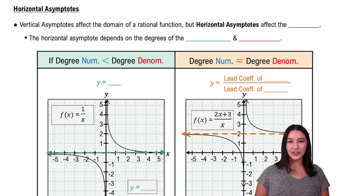
Exponential functions have horizontal asymptotes that the graph approaches but never touches. The asymptote is typically y=0 for basic functions, but vertical shifts move it up or down. In the given graph, the asymptote at y = -1 indicates a vertical shift downward by 1.
Recommended video:
4:48
Determining Horizontal Asymptotes