Given , and , find each product, if possible. See Examples 5–7. AB
Ch. 5 - Systems and Matrices

Chapter 6, Problem 75
Perform each operation, if possible.
Verified step by step guidance1
Identify the dimensions of both matrices. The first matrix is a 3x2 matrix (3 rows and 2 columns), and the second matrix is a 2x2 matrix (2 rows and 2 columns).
Recall that matrix subtraction is only defined when both matrices have the same dimensions, meaning the same number of rows and columns.
Since the first matrix is 3x2 and the second is 2x2, their dimensions do not match.
Because the dimensions are different, the subtraction operation between these two matrices is not possible.
Therefore, you cannot perform the subtraction of a 3x2 matrix and a 2x2 matrix.

Verified video answer for a similar problem:
This video solution was recommended by our tutors as helpful for the problem above.
Video duration:
1mWas this helpful?
Key Concepts
Here are the essential concepts you must grasp in order to answer the question correctly.
Matrix Dimensions and Compatibility
Matrix operations like addition and subtraction require the matrices to have the same dimensions. This means the number of rows and columns in both matrices must be equal for the operation to be defined.
Recommended video:
Guided course
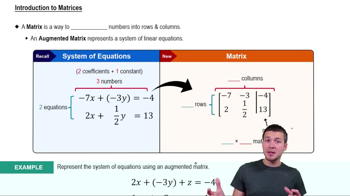
Introduction to Matrices
Matrix Subtraction
Matrix subtraction involves subtracting corresponding elements from two matrices of the same size. Each element in the resulting matrix is found by subtracting the element in the second matrix from the element in the first matrix at the same position.
Recommended video:
Adding & Subtracting Functions
Understanding Matrix Notation
Matrix notation uses rows and columns to organize elements. A 3x2 matrix has 3 rows and 2 columns, while a 2x2 matrix has 2 rows and 2 columns. Recognizing these helps determine if operations like subtraction are possible.
Recommended video:
Interval Notation
Related Practice
Textbook Question
57
views
Textbook Question
Use Cramer's rule to solve each system of equations. If D = 0, then use another method to determine the solution set. See Examples 5–7.
(1/2)x + (1/3)y = 2
(3/2)x - (1/2)y = -12
724
views
Textbook Question
Consider the following nonlinear system. Work Exercises 75 –80 in order.
y = | x - 1 |
y = x2 - 4
How is the graph of y = | x - 1 | obtained by transforming the graph of y = | x |?
534
views
Textbook Question
For what value(s) of k will the following system of linear equations have no solution? infinitely many solutions?
x - 2y = 3
-2x + 4y = k
974
views
Textbook Question
Perform each operation, if possible.
68
views
Textbook Question
Use Cramer's rule to solve each system of equations. If D = 0, then use another method to determine the solution set. See Examples 5–7.
2x - y + 4z = -2
3x + 2y - z = -3
x + 4y - 2z = 17
804
views