Ch. 8 - Sequences, Induction, and Probability
Blitzer - College Algebra 8th Edition
Blitzer8th EditionCollege AlgebraISBN: 9780136970514Not the one you use?Change textbook
Chapter 9, Problem 37

Write the first three terms in each binomial expansion, expressing the result in simplified form. (y3 − 1)20

Verified step by step guidance
1
Identify the binomial expression and the exponent: the expression is \((y^{3} - 1)^{20}\), where \(a = y^{3}\), \(b = -1\), and \(n = 20\).
Recall the Binomial Theorem formula for expansion: \(\displaystyle (a + b)^n = \sum_{k=0}^n \binom{n}{k} a^{n-k} b^k\), where \(\binom{n}{k}\) is the binomial coefficient.
Write the first three terms of the expansion by substituting \(k = 0, 1, 2\) into the formula:
\[\text{Term}_k = \binom{20}{k} (y^{3})^{20-k} (-1)^k\]
Simplify each term by calculating the binomial coefficients, powers of \(y^{3}\) (which become \(y^{3(20-k)}\)), and powers of \(-1\), then express each term in simplified form.

Verified video answer for a similar problem:

This video solution was recommended by our tutors as helpful for the problem above.
Video duration:
6m
Was this helpful?

Key Concepts

Here are the essential concepts you must grasp in order to answer the question correctly.

Binomial Theorem

The Binomial Theorem provides a formula to expand expressions of the form (a + b)^n into a sum involving terms with binomial coefficients. Each term is given by C(n, k) * a^(n-k) * b^k, where C(n, k) is the binomial coefficient representing combinations. This theorem is essential for finding specific terms in the expansion without fully multiplying the expression.
Recommended video:
Guided course
03:41
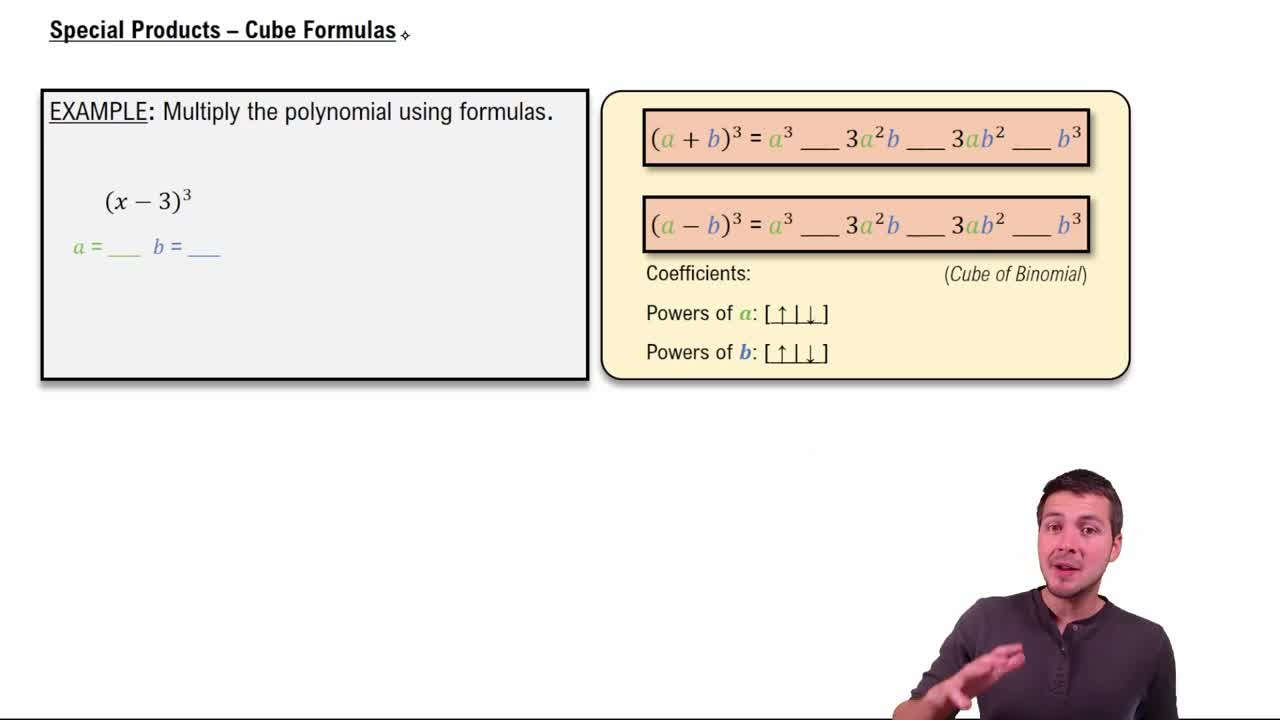
Special Products - Cube Formulas

Binomial Coefficients

Binomial coefficients, denoted as C(n, k) or "n choose k," count the number of ways to choose k elements from a set of n elements. They appear as coefficients in the binomial expansion and can be calculated using factorials or Pascal's Triangle. Understanding these coefficients is crucial for determining the coefficients of each term in the expansion.
Recommended video:
Guided course
03:41
Special Products - Cube Formulas

Simplifying Powers and Expressions

After applying the Binomial Theorem, each term often involves powers of variables and constants. Simplifying these powers, such as (y^3) raised to a power, requires using exponent rules like (a^m)^n = a^(m*n). Simplification ensures the final terms are expressed in their simplest form, making the expansion clear and concise.
Recommended video:
Guided course
05:07
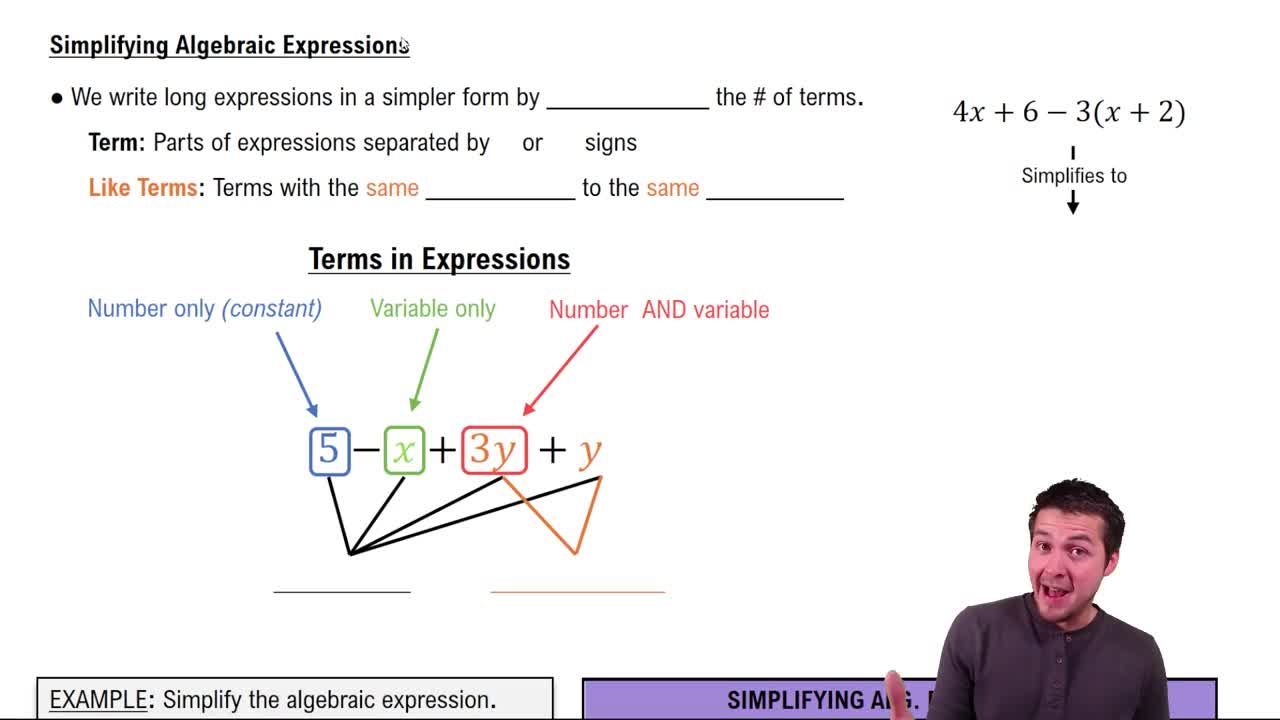
Simplifying Algebraic Expressions