Ch. 4 - Inverse, Exponential, and Logarithmic Functions
Lial - College Algebra 13th Edition
Lial13th EditionCollege AlgebraISBN: 9780136881063Not the one you use?Change textbook
Chapter 5, Problem 37

Solve each equation. log1/2 (x+3) = -4

Verified step by step guidance
1
Recall the definition of a logarithm: if \(\log_{a}(b) = c\), then it is equivalent to the exponential form \(a^{c} = b\).
Rewrite the given equation \(\log_{\frac{1}{2}}(x+3) = -4\) in exponential form using the base \(\frac{1}{2}\) and the result \(-4\): \(\left(\frac{1}{2}\right)^{-4} = x + 3\).
Simplify the expression \(\left(\frac{1}{2}\right)^{-4}\) by applying the negative exponent rule: \(a^{-n} = \frac{1}{a^{n}}\).
After simplification, solve for \(x\) by isolating it on one side: \(x = \left(\frac{1}{2}\right)^{-4} - 3\).
Check the solution by substituting \(x\) back into the original logarithmic equation to ensure the argument \(x+3\) is positive and the equation holds true.

Verified video answer for a similar problem:

This video solution was recommended by our tutors as helpful for the problem above.
Video duration:
3m
Was this helpful?

Key Concepts

Here are the essential concepts you must grasp in order to answer the question correctly.

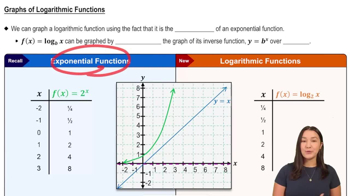
Logarithmic Functions and Their Properties

A logarithmic function is the inverse of an exponential function. The expression log_b(a) answers the question: to what power must the base b be raised to get a? Understanding how to manipulate and interpret logarithms is essential for solving equations involving logs.
Recommended video:
5:26
Graphs of Logarithmic Functions

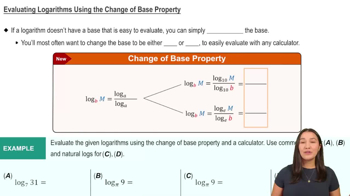
Change of Base and Evaluating Logarithms

Evaluating logarithms with bases other than common bases (10 or e) often requires rewriting the logarithmic equation in exponential form. This allows solving for the variable by isolating it and using properties of exponents.
Recommended video:
5:36
Change of Base Property

Domain Restrictions in Logarithmic Equations

The argument of a logarithm (the value inside the log) must be positive. When solving log_b(x+3) = -4, it is important to ensure that x+3 > 0 to maintain the equation's validity and avoid extraneous solutions.
Recommended video:
3:51
Domain Restrictions of Composed Functions