Dimensions of a Rug. Zachary wants to buy a rug for a room that is 12 ft wide and 15 ft long. He wants to leave a uniform strip of floor around the rug. He can afford to buy 108 ft2 of carpeting. What dimensions should the rug have?
Ch. 1 - Equations and Inequalities

Chapter 2, Problem 24
Solve each equation using the zero-factor property. 36x2 + 60x + 25 = 0
Verified step by step guidance1
Recognize that the equation \$36x^2 + 60x + 25 = 0\( is a quadratic equation and check if it can be factored into the form \)(ax + b)(cx + d) = 0$.
Look for two numbers that multiply to \(36 \times 25 = 900\) and add up to \(60\), which will help in factoring the middle term.
Rewrite the middle term \$60x$ as the sum of two terms using the numbers found in the previous step, then group the terms to factor by grouping.
Factor out the greatest common factor from each group to express the quadratic as a product of two binomials, i.e., \((mx + n)(px + q) = 0\).
Apply the zero-factor property by setting each factor equal to zero: \(mx + n = 0\) and \(px + q = 0\), then solve each linear equation for \(x\).

Verified video answer for a similar problem:
This video solution was recommended by our tutors as helpful for the problem above.
Video duration:
1mWas this helpful?
Key Concepts
Here are the essential concepts you must grasp in order to answer the question correctly.
Zero-Factor Property
The zero-factor property states that if the product of two factors equals zero, then at least one of the factors must be zero. This property is essential for solving polynomial equations by factoring, as it allows us to set each factor equal to zero and solve for the variable.
Recommended video:
Guided course
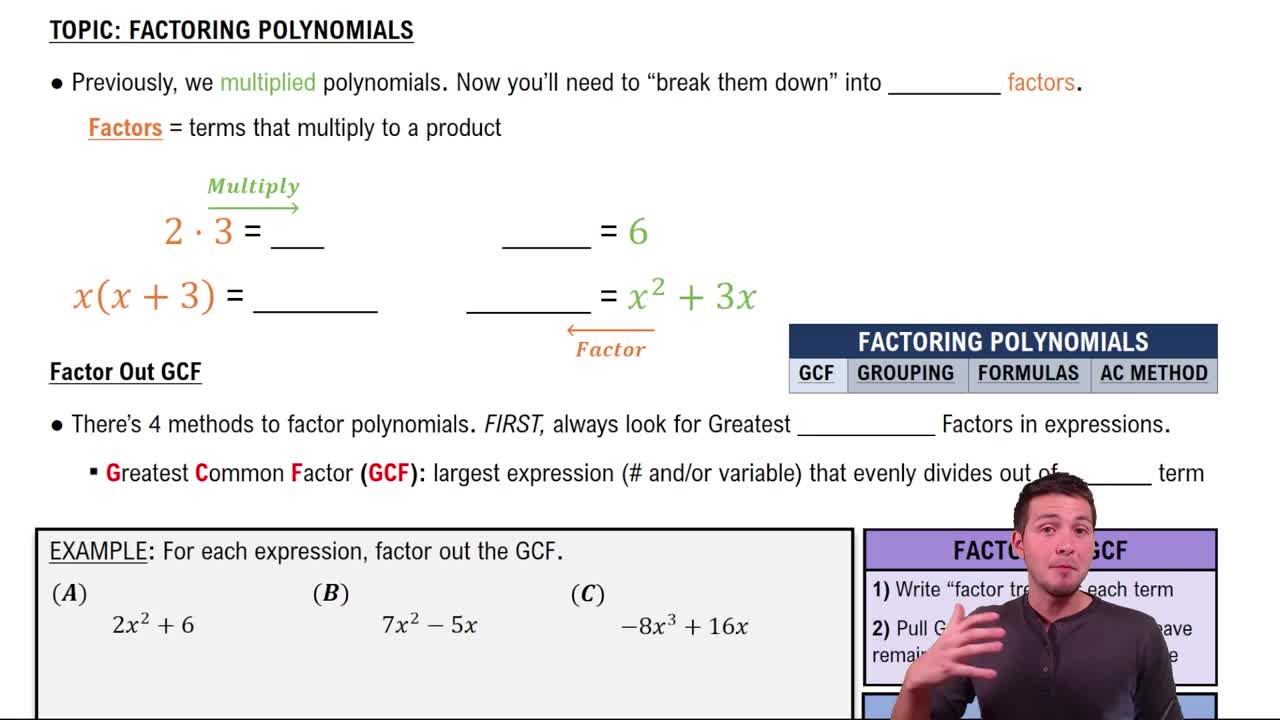
Introduction to Factoring Polynomials
Factoring Quadratic Expressions
Factoring quadratic expressions involves rewriting a quadratic equation in the form ax^2 + bx + c as a product of two binomials. This step is crucial before applying the zero-factor property, as it breaks down the equation into simpler parts that can be individually set to zero.
Recommended video:
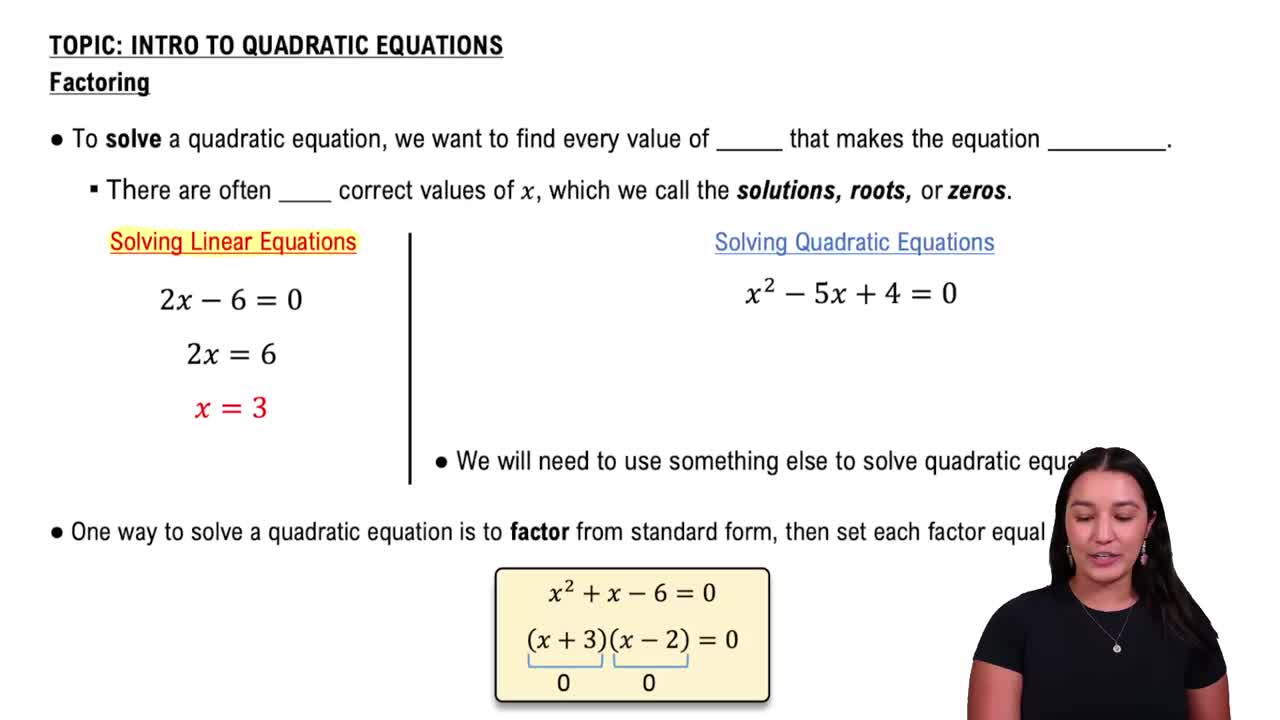
Solving Quadratic Equations by Factoring
Solving Quadratic Equations
Solving quadratic equations means finding the values of the variable that satisfy the equation. After factoring and applying the zero-factor property, each resulting linear equation is solved to find the roots or solutions of the original quadratic.
Recommended video:
Solving Quadratic Equations by Factoring
Related Practice
Textbook Question
106
views
Textbook Question
Perform each operation. Write answers in standard form. (-8+2i)(-1+i)
822
views
1
rank
Textbook Question
Solve each inequality. Give the solution set in interval notation. -(2/3)x-(1/6)x+(2/3)(x+1)≤4/3
1964
views
Textbook Question
Solve each equation. -4(2x-6) +8x= 5x+24+x
879
views
Textbook Question
Solve each equation. 3/(x2+x-2) - 1/(x2-1) = 7/(2x2+6x+4)
585
views
Textbook Question
Solve each problem. See Example 2. At the 2008 Summer Olympics in Beijing, Usain Bolt set a new Olympic and world record in the 100-m dash with a time of 9.69 sec. If this pace could be maintained for an entire 26-mi marathon, what would his time be? How would this time compare to the fastest time for a marathon, which is 2 hr, 3 min, 23 sec, set in 2013? (Hint: 1 m ≈ 3.281 ft.) (Data from Sports Illustrated Almanac.)
682
views
